Zwei niederösterreichische Literaturzeitschriften haben in den vergangenen Wochen Prosa von Gerald Jatzek vorgestellt.
Das Podium widmet die Nummer 203/204 dem Neustart. Neben der naheliegenden Interpretation nach zwei Jahren Einschränkungen durch die Pandemie finden sich etwa Texte über eine erschwerte berufliche Neuorientierung (Thomas Northoff) und eine Interpretation der Welt, die zunehmend aus der Zeit fällt. Katja Renzlers Miniaturen regen die Gedanken zu unzähligen möglichen Fortsetzungen und Interpretationen an. Und Anna Ladurner erzählt die Geschichte einer Frühgeburt, die im Spannungsfeld von Mutter und Kind Prägungen folgt, die uns nur selten bewusst sind.
In der Ausgabe 87 des etcetera geht es um Türme, reale wie imaginierte. Zunächst lädt Klaus Ebner auf eine Tour d’Horizon durch die Geschichte der Türme ein, dann führt Karin Leroch durch mystisch-erotische Begegnungen, und schließlich interpretiert Dana Schällert den Mythos der im bronzenen Turm eingeschlossenen Danae in einem Gedicht. Interviews gibt es mit dem Heftkünstler Wilhelm Koller (von Eva Riebler) und dem Autor und Gründer der Leondinger Literaturakademie Gustav Ernst (von Gabriele Müller).
Gerald Jatzek ist in beiden Publikationen mit jeweils einer Geschichte aus der in Arbeit befindlichen Sammlung Die Welt, einer Sammlung von Träumen, Wachträumen und Fantasien, vertreten.
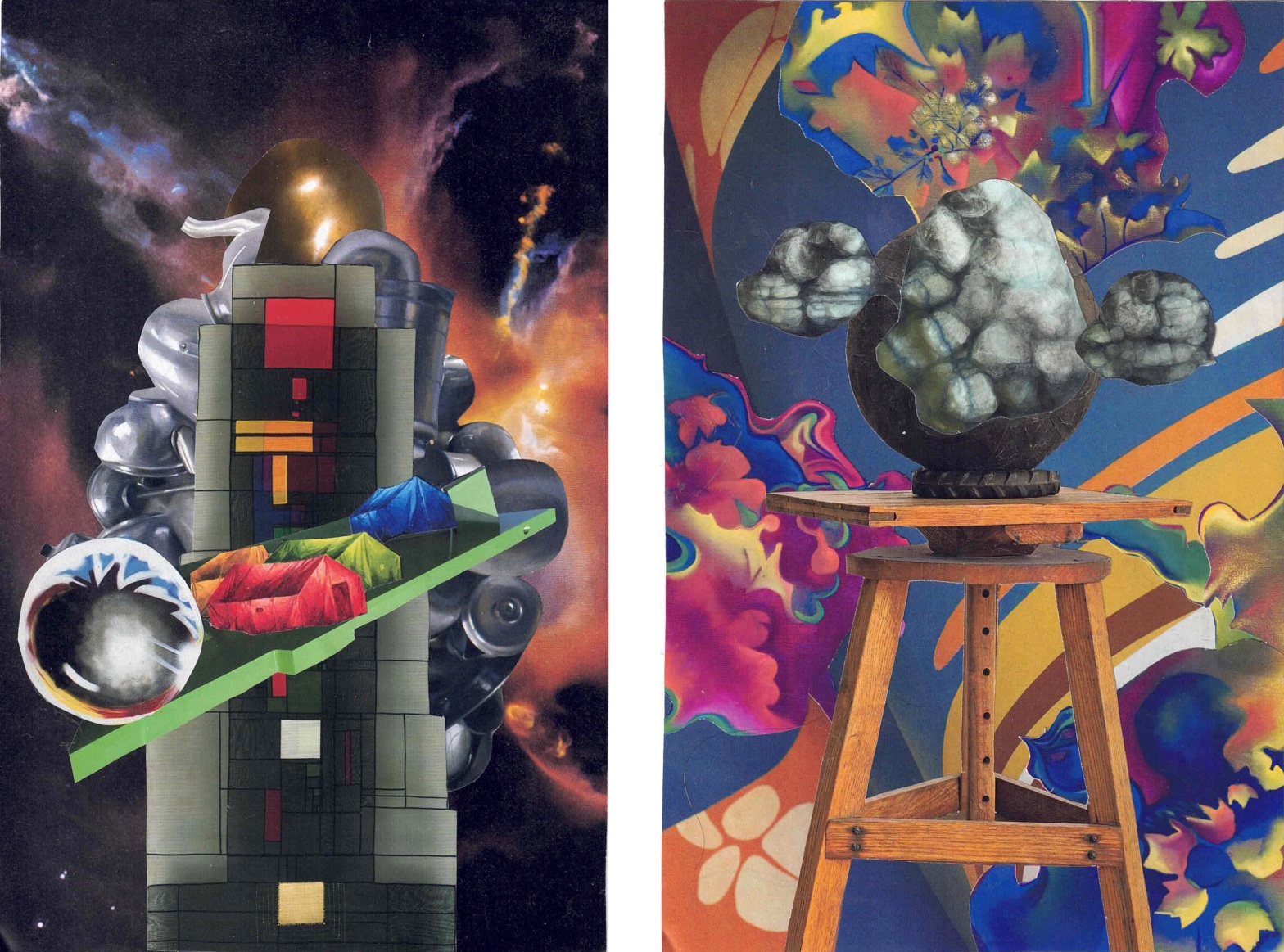
Two wonderful collages from Seattle reached Vienna on the last day of March. They are works of Melanie Reed, titled New Year’s Eve and Object Lesson.
Both images – Melanie calls them “unlikely art visions” – show a strong tension between a static central object and a background filled with colorful objects moving in a variety of directions.
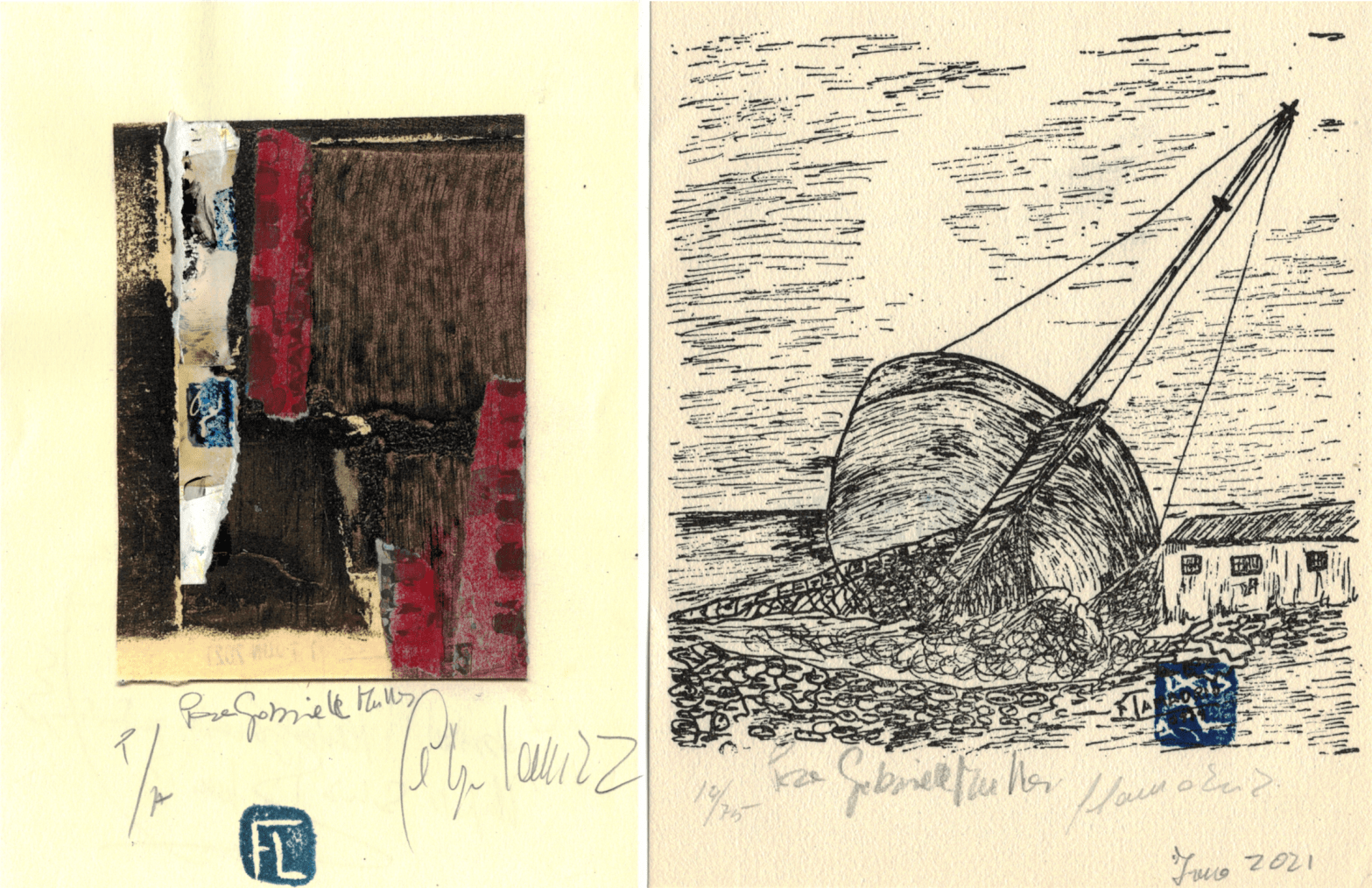
Sometimes things disappear on hard disks. Eventually, they turn up again. This happened to two works of Felipe Lamadrid which reached Austria in June 2021.
They were scanned, they were prepared for publication – and then they somehow slipped into the wrong folder. They reappeared a few days ago, and therefore they can finally be shared on this site.
The two prints came with dedications for Gabriele who took part in Felipe’s exhibition ojo por ojo. Due to the fact that traveling was severely restricted last year, she was especially pleased with the large fishing boat.
The Arnolfini Archívum’s challenge no. 58 for Mini[e]MailArt is “packages”. And although this motto leaves ample possibilities for artistic interpretations, I felt that the Russian assault on the Ukraine could not be ignored.
This is why:
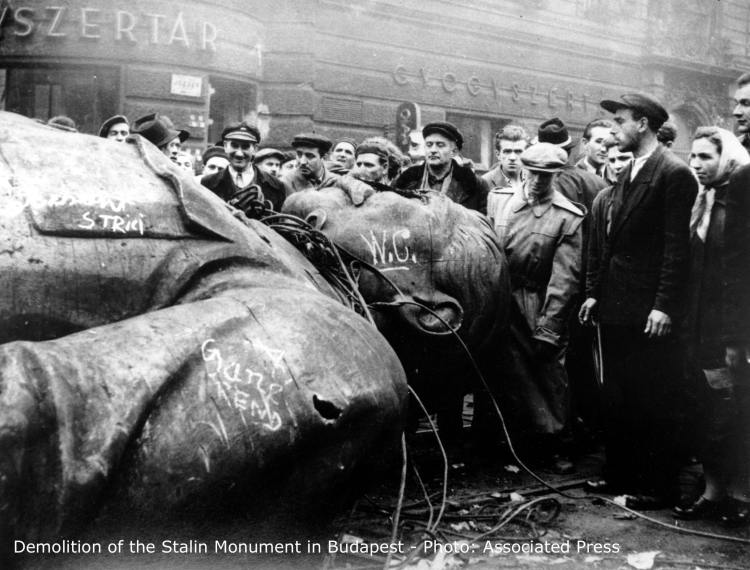
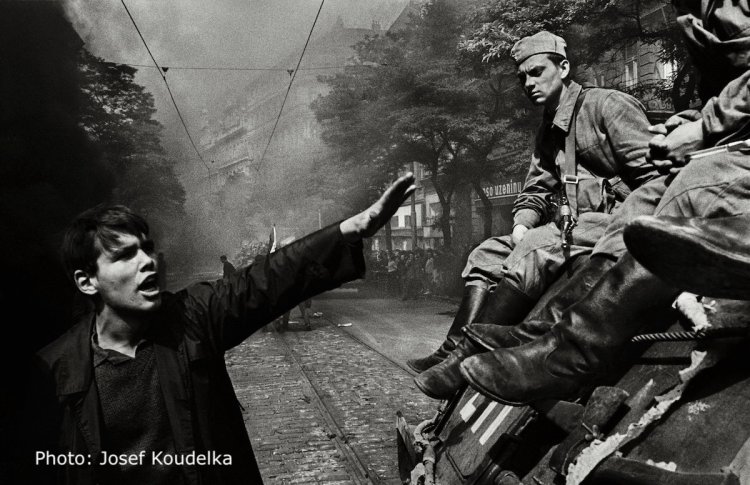
Russia’s supreme Leader Vladimir Putin calls the war on Ukraine a “special military operation”. Thus, he continues the tradition of the USSR and the Warsaw Pact troops that trivialized the invasions of the German Democratic Republic (1953), Hungary (1958) and Czechoslovakia (1968) as a form of “brotherly help”.
These were the lies in 1956
“On the request of the Hungarian People’s Government the Soviet Government consented to the entry into Budapest of the Soviet Army units to assist the Hungarian People’s Army and the Hungarian authorities to establish order in the town.” (Moscow Radio, 30.10.1956)
And this was the truth:
Soviet troops started to attack Budapest and other cities on November 4. From shortly after 5 am on the Hungarian radio repeatedly aired an official statement:
“This is Imre Nagy speaking, Chairman of the Council of Ministers of the Hungarian People’s Republic. In the early hours of this morning, Soviet troops started an attack on our capital with the obvious aim of overthrowing the legal and democratic Hungarian government.”
“Luckily, the Russians came as friends. Just imagine the consequences if they had come as enemies!”
(Hungarian underground joke, 1956)
Approximately 2,700 Hungarians were killed during the following days. More than half of them were under the age of thirty. 274,704 Hungarians fled to Austria until April, 1957, and 19,181 refugees sought shelter in Yugoslavia.
Imre Nagy, Defense Minister Pál Maléter and others were executed after an infamous show trial in 1958. For Soviet leader Nikita Khrushchev the juridical murder served “as a lesson to all other leaders in socialist countries”.
This was the up-is-down narrative of 1968
“(…) we deemed it necessary to comply with the request of our Czechoslovak friends and help the peoples of Czechoslovakia in defense of the conquests of socialism, and consequently, we ordered our military units to take the necessary measures and grant assistance to the Czechoslovak working people.”
(Letter from the Central Committees of the Bulgarian, East German, Hungarian, Polish, and Soviet Communist Parties, 19.07.1968)
The truth was quite different:
On August 20 1968, Czechoslovakia was invaded by about 250,000 Warsaw Pact troops from the Soviet Union, Poland, Bulgaria, and Hungary. Subsequently the number of foreign troops rose to 500,000. They claimed to have been officially called for assistance, an assertion that was rejected by members of the government and Communist leaders alike. The KSČ party even condemned the invasion on their clandestine 14th congress.
“After enjoying great popular confidence after the war, the Communist Party by degrees bartered this confidence away for office – until it had all the offices and nothing else…“
Ludvik Vaculik (1968)
People instantly gathered in Prague and other cities and demanded the immediate withdrawal of foreign troops. The Czech delegation at the United Nations declared that the invasion was illegal and threatened the sovereignty of their nation. While Soviet tanks surrounded the building of Radio Prague, a female announcer told the public, “They are going to silence our voices, but they cannot silence our hearts.”
And this is the version of 2022
Putin claims that the Russian forces “will seek to demilitarize and denazify Ukraine, as well as bring to trial those who perpetrated numerous bloody crimes against civilians, including against citizens of the Russian Federation.” (Televised speech, 24.02.2022)
The New York Times thoroughly analyzed Putin’s remarks and concluded, “His reference to ‘demilitarize’ is being widely read as a threat to subjugate the Ukrainian state as a whole, neutering its ability to defend itself and therefore its sovereign autonomy.”
“Russia and Putin have united the Ukrainian and Jewish people, the whole world, against them. We have all become victims of the same tragedy.”
Rabbi Moshe Reuven Azman, Kyiv
A lengthy list of scholars of Genocide, Nazism and World War II rejected Putin’s claims as a “cynical abuse of the term genocide, the memory of World War II and the Holocaust” and his “misuse of the history of World War II to justify its own violence”.
There is no way that any person committed to democratic values can accept the goals and deeds of Russia’s dictatorial government. No matter how you look at it, the Ukrainian people are experiencing an imperialist invasion. They are fighting for the sovereignty of their country.
La vida de Dante Alighieri era un viajar constante, un viaje inacabado e indeciso entre una nostalgia paradójica por la ciudad de Florencia, que amaba y odiaba a la vez.
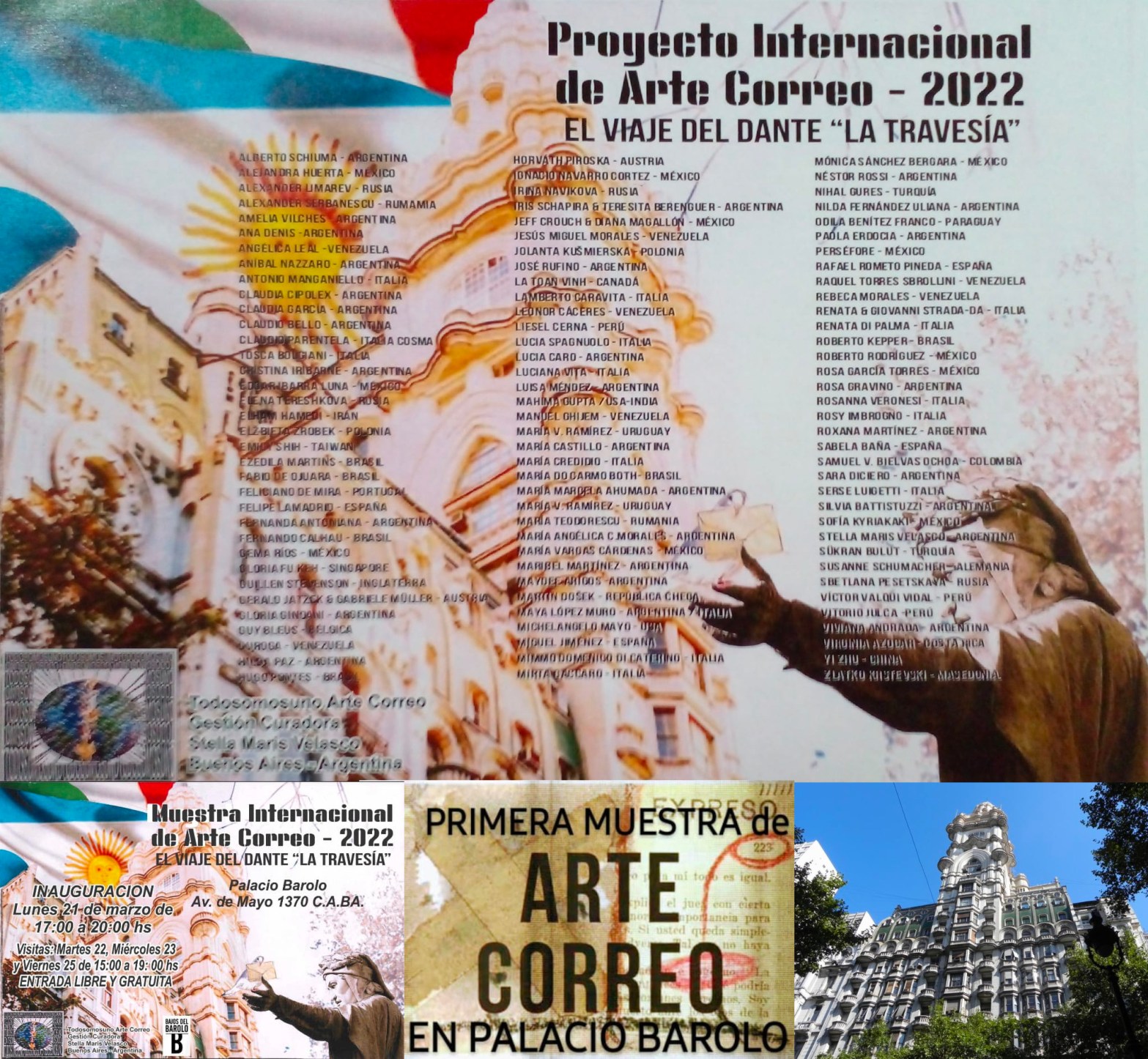
En el año 2021, se conmemoraron los 700 años del fallecimiento de Dante Alighieri. Es cuando mail art convocó a un viaje imaginario, para dar tributo a Dante que nunca logró llegar a Argentina.
La exposición, organizada por el Grupo de Tartarugacorreo y Stella Maris Velasco,se realiza desde el 21 de marzo en el célebre Palacio Barolo. Se mostran 140 obras de artistas de 30 países
El Palacio de Dante
El Palacio Barolo guarda una increíble historia. Construido por el arquitecto Mario Palanti a pedido del industrial Luis Barolo, el monumental edifico era previsto para albergar las cenizas del poeta italiano.
Este “santuario”, ubicado en la Avenida de Mayo en el barrio Montserrat de Buenos Aires, es una creación única, recreando en su estructura La Divina Comedia. Sus 22 pisos, al igual que las estrofas de los versos de la obra maestra de Dante, contienen tres partes: Infierno, Purgatorio y Cielo. La primera parte alegórica ocupa los dos subsuelos, el Purgatorio, del piso uno al 14, refleja los siete pecados capitales. Desde el Paraíso se puede acceder al mirador con su vista impresionante por toda la ciudad.
Aunque nunca hayan llegado las cenizas de Dante Alighieri:
En Marzo de 2022 llegaron a Argentina 140 obras de artistas de 30 países, expuestas primero en el Museo de Arte Contemporáneo Beato Angèlico, La Plata, y, desde el 21 de marzo de 2022 en el Palacio Barolo.
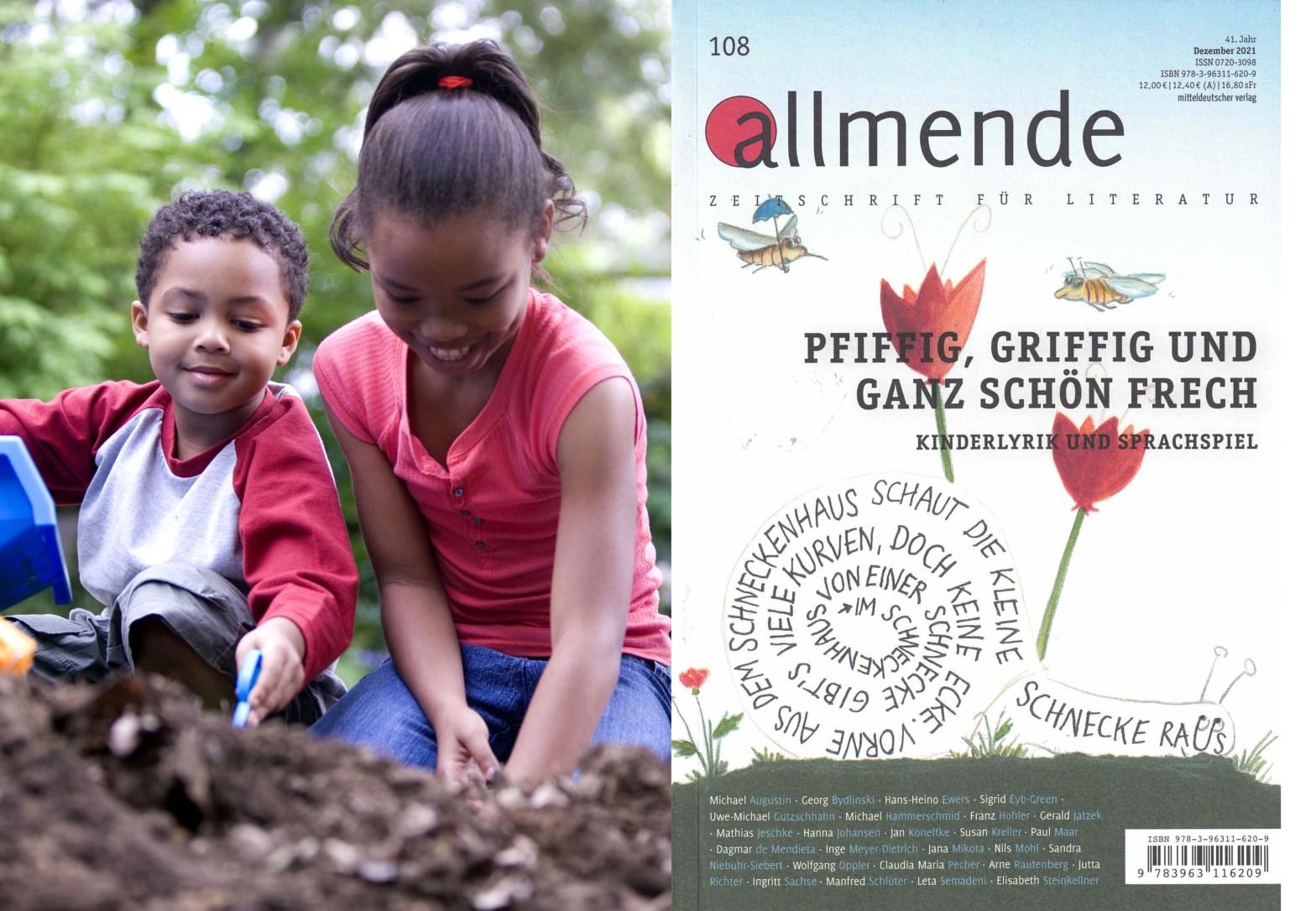
Wodurch zeichnet sich Kinderlyrik aus? Welche Erscheinungsformen gibt es? Worin bestehen Gemeinsamkeiten mit und Unterschiede zur Lyrik für Erwachsene? Inwiefern fördert sie den spielerischen Umgang mit Sprache?
Die Jubiläumsausgabe der Zeitschrift Allmende stellt aktuelle Positionen aus der Forschung sowie aus dem Literaturbetrieb vor und beleuchtet die sprachliche und gestalterische Vielfalt der Kinderlyrik.
Die von Kim Lea Väth unterstützte Redaktion bleibt aber nicht bei der Theorie. Zahlreiche Gedichte, die auch Erwachsenen Spaß machen, stehen im Zentrum der Ausgabe.
Uwe-Michael Gutzschhahn und Mathias Jeschke schreiben über die Möglichkeiten des Gedichtes, das mit einigen Wörtern eine Geschichte im Kopf der Lesenden oder Hörenden anregen kann, aber auch befreit und verblüfft, wenn es Verhältnisse auf den Kopf stellt. Die Beiträge unter dem Motto “Fünf Fragen – fünf Antworten” zeigen schlaglichtartig Sichtweisen im Bereich der Kinderlyrik auf, vom Verfassen bis zur Prüfung auf gesellschaftsverändernde Inhalte.
Die Gedichte stammen von Michael Augustin, Georg Bydlinski, Dagmar de Mendieta, Sigrid Eyb-Green, Michael Hammerschmid, Franz Hohler, Gerald Jatzek, Jan Koneffke, Susan Kreller, Paul Maar, Jana Mikota, Nils Mohl, Arne Rautenberg, Ingritt Sachse, Manfred Schlüter, Leta Semadeni, Elisabeth Steinkellner u. a.
Children in the world is the theme of an Italian mail art project, organized by the cultural association Kunst Grenzen – Arte di Frontiera and curated by the artist Renata di Palma.
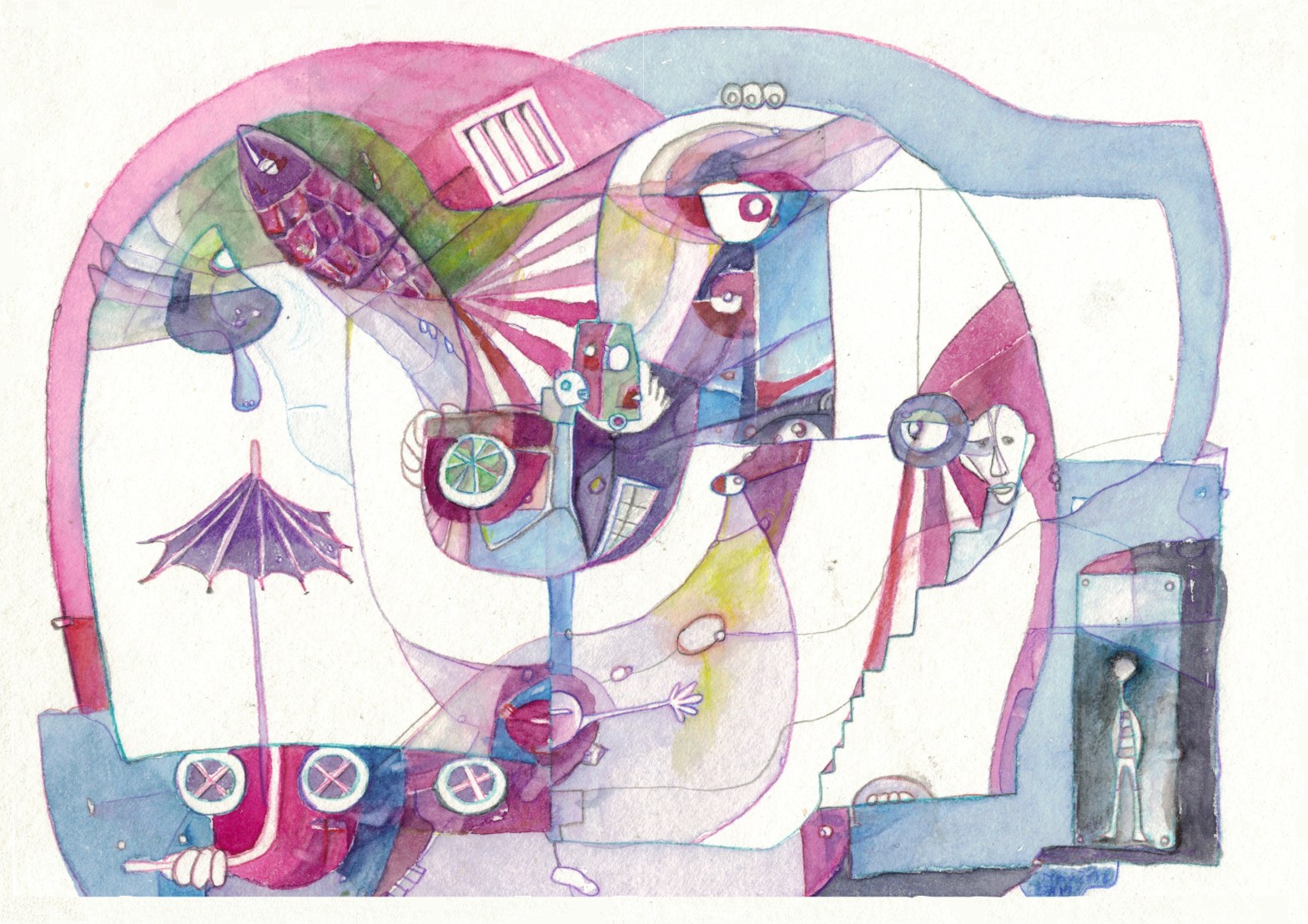
Gabriele took part with a watercolor painting named bambini. When asked about the background of her work, she says that children need an umbrella to protect themselves and their fantasy.
The submissions will be published, on the social media presence of the association as well as on the official website.
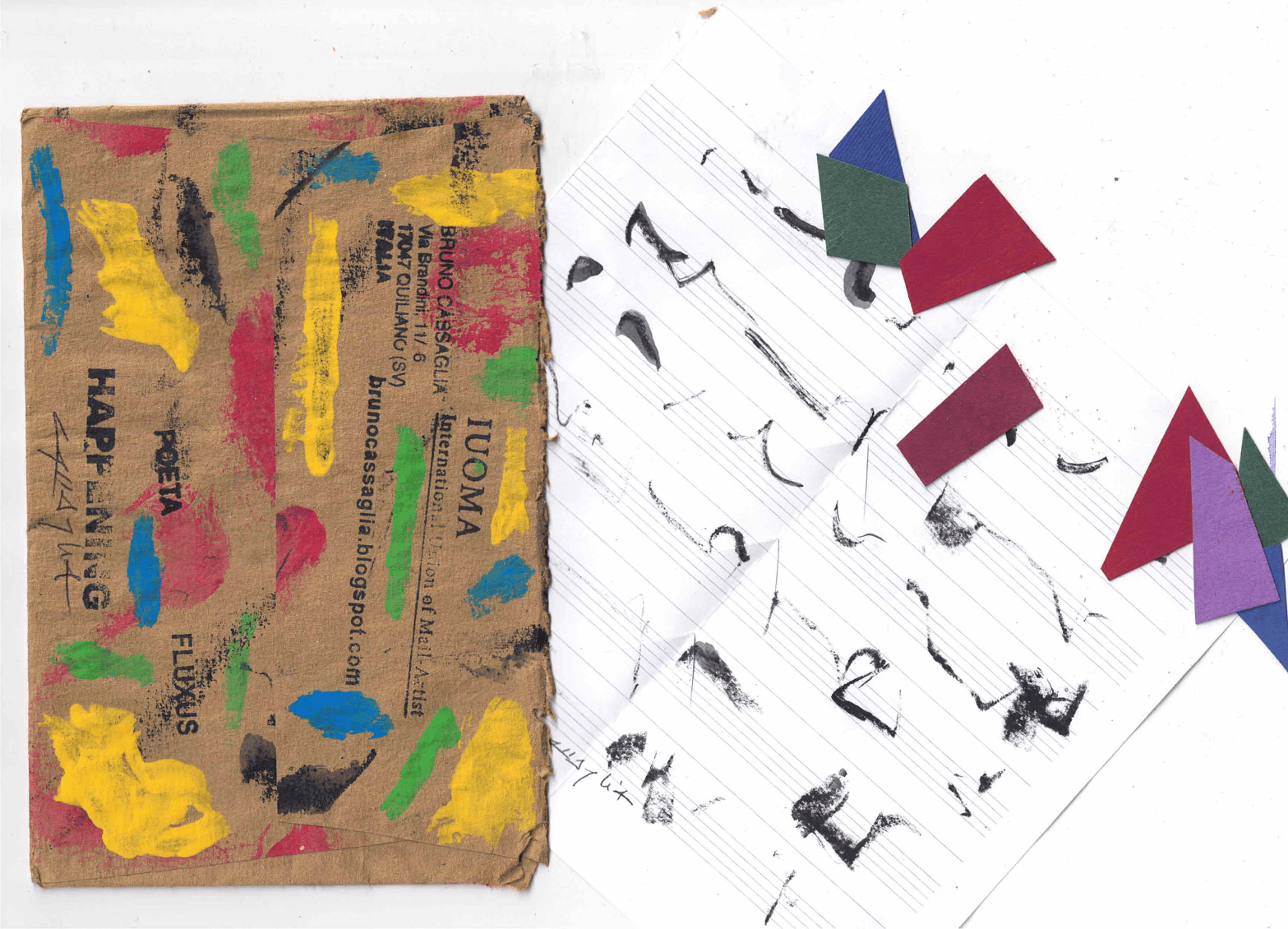
Bruno Cassaglia from Quiliano, a small town in the province Savona, sent a mixed lot of things. He included a text that proved rather enigmatic. It starts with the lines
Quanti cieli oltre i cieli posso pensare? Quali altri universi impermiabili? Solo Dio lo sa solo solo solo mi sento solo
Translated:
How many skies beyond the skies can I think? How many other impermeable universes? Only God knows only only only I feel lonely
Furthermore, the painted envelope included two drawings, a painted envelope, and a lot of colored triangles and squares. They may or may not form an extended tangram.
“El viaje de Dante. ¿Quién lo ha visto? fue una convocatoria de arte correo organizada por el Grupo de Tartarugacorreo y Stella Maris Velasco.
En Marzo de 2022 llegaron a Argentina 140 obras de artistas de 30 países. La primera muestra, realizada por Maya López Muro, fue expuesta en el Museo de Arte Contemporáneo “Beato Angélico”, en La Plata, Buenos Aires.
Desde el 21 de marzo se realiza la segunda exposiciòn en el Palacio Barolo.
El séptimo círculo infernal
Nuestra contribución combina la descripción del infierno de Dante con la historia reciente de Argentina. En el séptimo círculo infernal se castigan a los asesinos y tiranos, hundiéndolos en un río de sangre hirviente, llamado Flegotonte. Aquí paga por sus crímenes el jefe de la dictadura cívico-militar que gobernó a Argentina entre el golpe de Estado del 24 de marzo de 1976 y la entrega del poder a un Gobierno constitucional el 10 de diciembre de 1983. El Estado burocrático-autoritario se caracterizó por establecer un plan sistemático de terrorismo estatal, que incluyó robo de bebés (y ocultamiento de su verdadera identidad) y desaparición de personas. La eliminación masiva de opositores ha sido considerada judicialmente como un genocidio.
Es la Asociación Civil “Abuelas de Plaza de Mayo”, que lucha por localizar y restituir a sus familias los bebés y niños apropiados por la dictadura, y obtener el castigo correspondiente para todos los responsables.
Los imágenes muestran la invitación para la inauguración de la exposición, el edificio de la UCALP y nuestra contribución.
When it comes to David L. O’Nan, a lot of people know what he is doing, while it is difficult to imagine, how he finds the time and the energy for all these activities. He is a poet and a writer of stories whose works have been published in books and literary magazines. Together with his wife HilLesha he is an avid collector and editor of poetry from all over the world. He runs a blog with articles about writing, music and art, maintains a Facebook presence and is active on twitter.
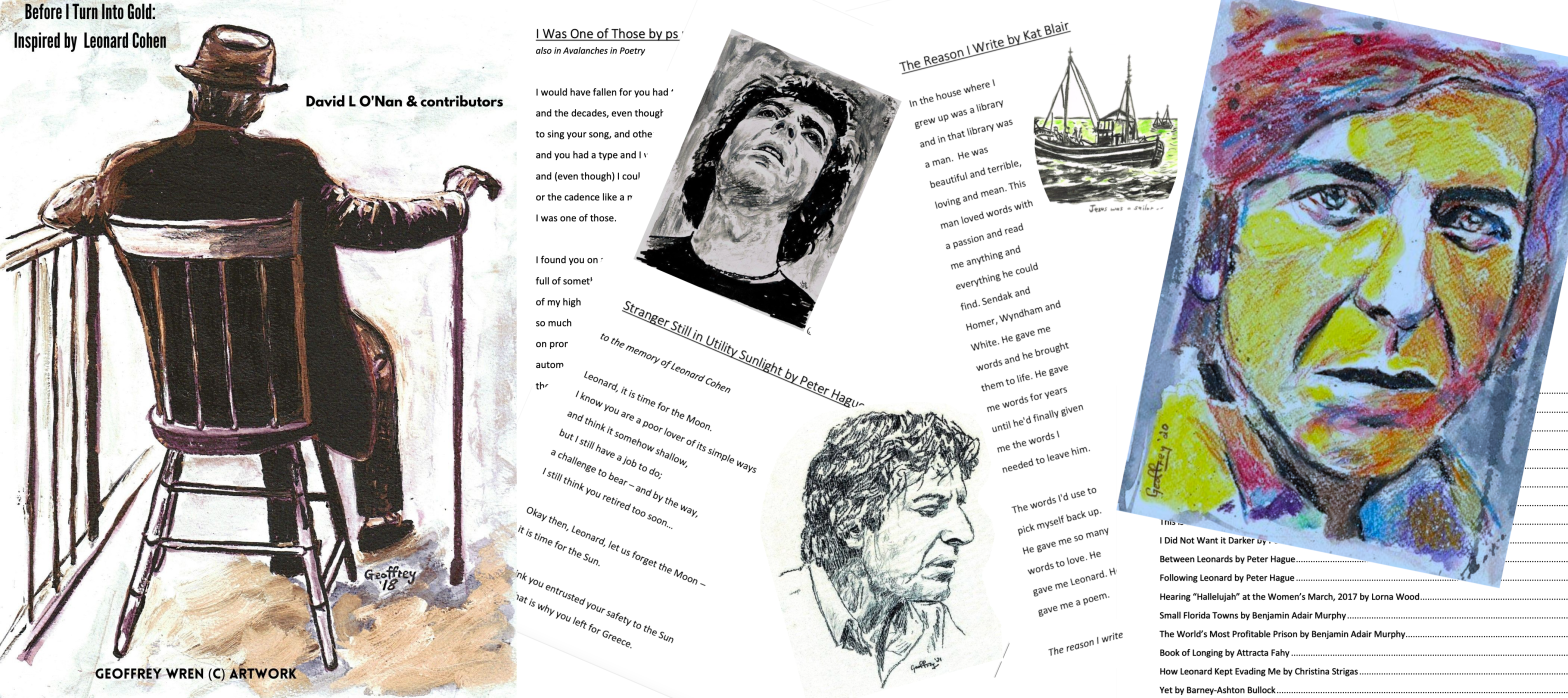
Right now, David and HilLesha have brought out an international 140-pages anthology with writings inspired by Leonard Cohen (1934-2016). Among the contributors are Kat Blair, Elizabeth Cusack, Peter Hague, Gerald Jatzek, Benjamin Adair Murphy, PS Pirro, Shane Schick, Samantha Terrell, and Arthur L Wood, to name just a few. They come from England, Ireland, Austria, New Zealand, Scotland, the USA, and, of course, Canada.
Interestingly, the majority of the texts are inspired by Cohen’s songs rather than his poetry or his novels. While the connections to the work of the Canadian poet are obvious in many contributions, there are some that start with one of his metaphors but develop into something unexpected.
The anthology is available in print or as an e-book through Amazon.
David & HilLesha O’Nan (Eds ): Before I Turn Into Gold: Writings And Art Inspired By Leonard Cohen, illustrations by Geoffrey Wren, Fevers of the Mind Press, Evansville, IN, USA 2022, ISBN-13: 979-8418312587
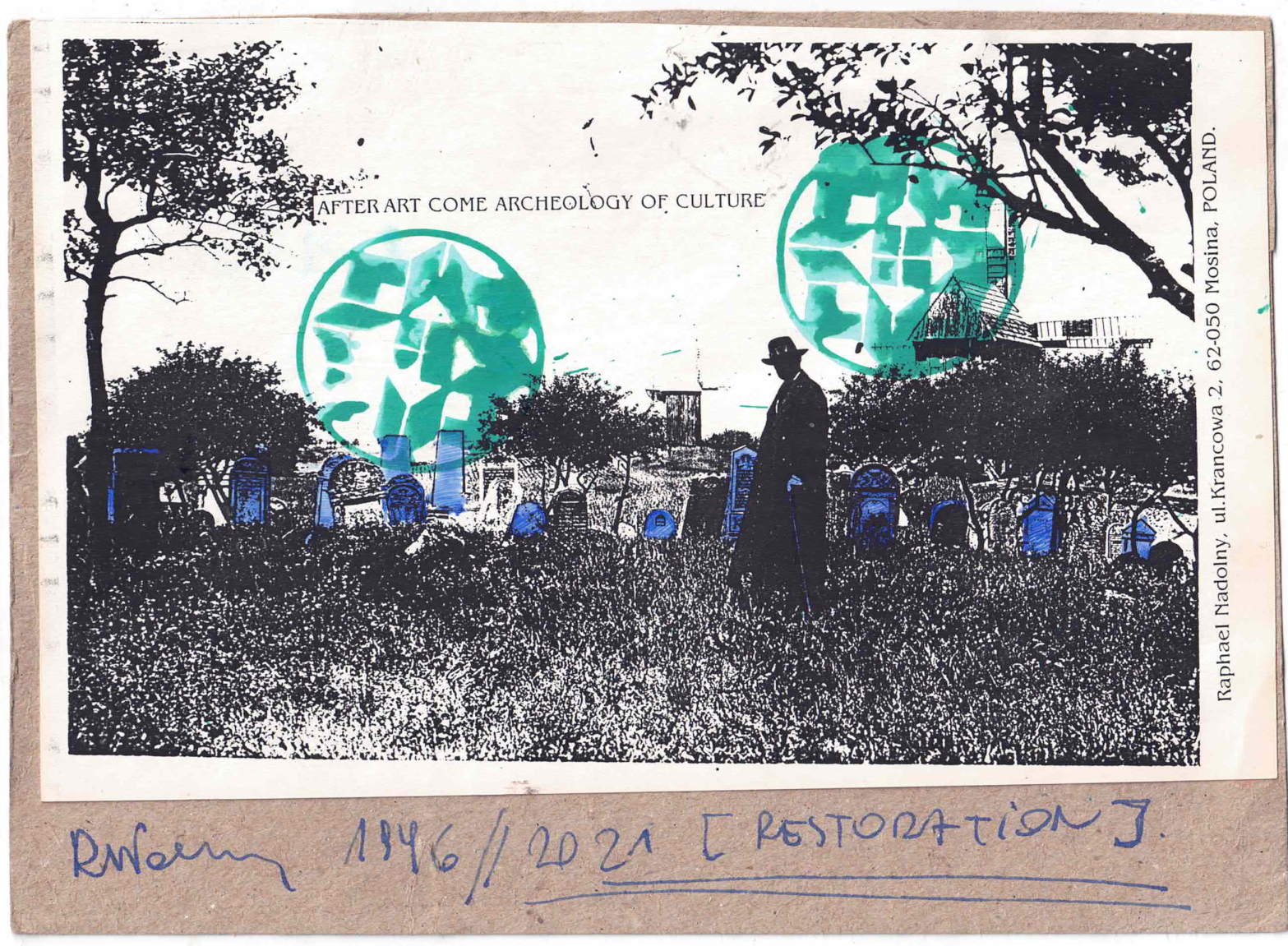
This large card is a work of Raphael Nadolny, who lives in the small Polish town of Mosina. The picture shows a catholic priest visiting a jewish cemetery in 1946. Nadolny calls the photocopy with colored gravestones an archeology of culture.
Ervin Zsubori, the mastermind behind Arnolfini’s Archives, is a man for all seasons: artist, photographer, economist, sociologist, journalist, poet and more. In the mail art community he is known for his collections on Arnolfini Mini[e]MailArt.
He regularly sends out organizes online exhibitions based on themed calls. They are quite challenging because the solutions have to fill an area of 600×600 pixels (300 dpi), no more, no less.
Contributions come from successful mail artists like Ryosuke Cohen, Ruud Janssen and Serse Luigetti as well as from largely unknown painters, photographers and mixed media artists from all over the world.
Here are the works that Gerald has provided for the last four online exhibitions [enlarge]. The topics were:
This is once again a cooperative piece, consisting of a watercolor painting and a poem. Together they tell the story of two persons who reciprocally appear in their dreams.
By the time you read this, the card should have already reached the Canadian mail artist Awyn.
…sang Jim Morrison in 1967. And while the music is over for the legendary frontman of the Doors, the sentence still holds true for many people. What this friend can do for you, is the theme of an anthology, edited by the US-based author Steve Carr.
From heartbeat to drumbeat, from birdsong to crooners from yesteryear, from piano keys to the strings of a sitar. In Stories & Poems in the Song of Life, 175 authors and poets worldwide explore the theme of music, from the melodious sounds of nature to the world of hard pounding rock and roll. Fiction is mixed with non-fiction as writers and poets take you on their musical journeys, imagined and real.
The song of life is our own unique tune – the essence of who we are – composed while listening to the music that surrounds us, in one form or another, from the time we are born to the time of our death.
Feel free to hum along as you read this incredible one-of-a-kind collection.
Some of the poems:
Composition by Gail Constable Unfortunate Strings by J.S. Mannino Reaching Places by Stephen Kingsnorth Street Corner Jam by Ed Ahern Granddaddy’s Song by Richard Doiron To Paint a Tune by Lynn White The Morning, Dim; It Chills But Not the Soul by David G. Harms Lady Day and Prez by Henry Wolstat I Am Time by Don Edwards Shimmering by Joan McNerney Up She Rises by Rachel R. Baum The Cellist by Shirani Rajapakse Don’t Stop by Afrose Saad That Fleeting Moment by DJ Elton Song of Nature by Christian Ward Music by John David Meadows Songs of Yesteryear by Dennis Brown Pennies From Heaven by Gerald Jatzek
Steve Carr (ed.): Stories & Poems in the Song of Life, Paperback, Sweetycat Press, Richmond, Va., USA, 425 pages (also available as Kindle eBook, $4.99)
Den Thomas Nemec kenne ich seit, also das ist gar nicht mehr wahr, wie man in Wien sagt. Getroffen haben wir uns in einem wunderbaren, unterirdischen Etablissement namens Club Hoffnungslos. Das war ein selbstverwaltetes Refugium in der damaligen Ödnis Floridsdorfs, das auch Leute aus der Umgebung anzog, weil in der Brigittenau und der Donaustadt damals ebensowenig los war.
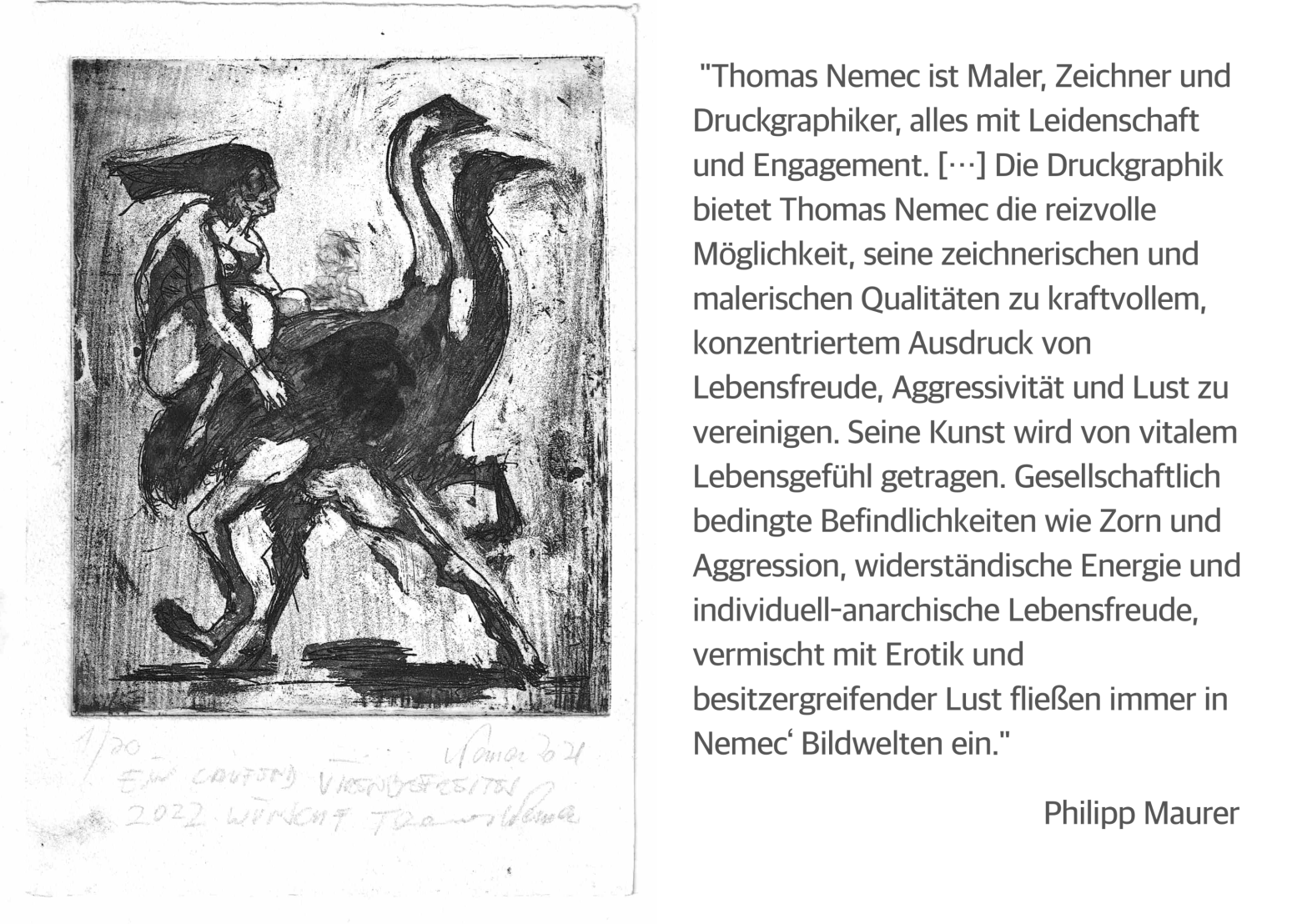
Inzwischen ist der Tommy Maler und Grafiker, aufmüpfig wie eh und je, und versendet wunderbare Kleinodien zum Jahresanfang. Diesmal sind es zwei Sträuße mit einer Reiterin, die in eine – wie sie hoffen – virenbefreite Zukunft rennen.
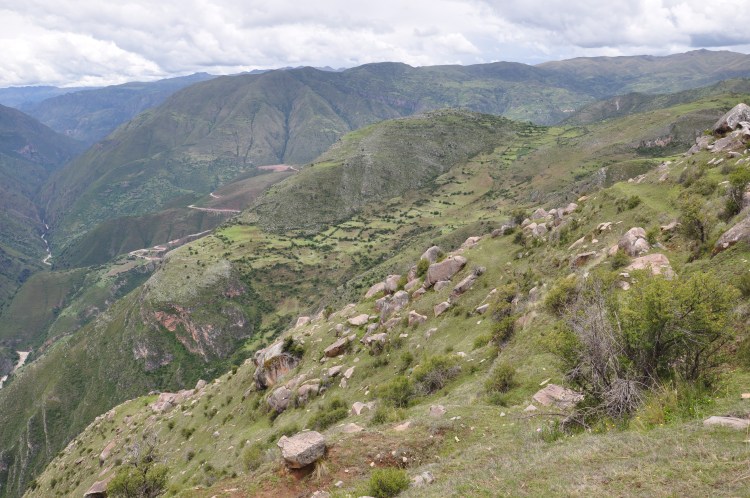
El libro Chumbivilcas – arte rupestre y paisajes sagrados del autor Rainer Hostnig llena un vacío en la investigación arqueológica no sólo en el Perú. Por su difícil acceso y la carencia de obras monumentales de la época incaica, el patrimonio arqueológico de la región no fue objeto de excavaciones o iniciativas de protección hasta finales del siglo XX. Por ello, los sitios por mucho tiempo fueron dejados a merced de saqueadores de tumbas y excavadores clandestinos. La primera tesis universitario sobre el tema arqueológico de la provincia data del año 2000, cuando dos estudiantes presentaron los resultados de su investigación sobre los petroglifos de la región.
El autor y fotógrafo Rainer Hostnig, lingüista e ingeniero agrario, es conocido por su inventario nacional del arte rupestre del Perú publicado en el 2003. En su obra reciente se dedica a la investigación de la región de Chumbivilcas, una de las 13 provincias del departamento de Cusco. Analiza los vestigios rupestres en 68 sitios, hasta la fecha conocidos, con una variedad de estilos en los que se distinguen motivos naturalistas, seminaturalistas y abstractos. Simbolizan ideas y ocupaciones humanas, tanto de sociedades de tiempos del Período Arcaico como los posteriores en los tiempos incaicos e incluso coloniales y de la República temprana.
Campo de petroglifos de Intiyoq Rumi
Grabado colonial con representación
Roca con representaciones de camélidos y motivos abstractos en Intiyoq Rumi
Otra vista del campo de petroglifos Intiyoq Rumi
Motivos abstractos, representando quizá surcos agrícolas o un sistema de conteo
Hileras de camélidés, figuras humanas y depresiones semiesféricas, sitio rupestre Llama Machay en la comunidad Charamoray, fotos: R. Hostnig
Los hallazgos muestran en su mayor parte figuras de camélidos, lo que revela la importancia de estos animales para la supervivencia de las sociedades andinas. Utilizaron tanto la pintura como el grabado en rocas en los lugares sagrados más respetados para transmitir sus pensamientos y creencias ancestrales.
Estas expresiones culturales se hallan en abrigos rocosos, farallones, cuevas y en las caras de bloques de piedra al aire libre. Además de haber fungido como medio de comunicación de los antiguos pobladores, representan sus ideas y conceptos relacionados con su cosmovisión, sus ritos y vivencias, dando testimonio de la habilidad gráfica y de su capacidad de abstracción.
La documentación fotográfica fue realizada en su mayoría por el mismo autor Rainer Hostnig. Reconoce, que no fue una tarea fácil, debido al mal estado de conservación de gran parte de las pinturas y de los grabados. Fue necesario resaltar los colores mediante el software DStretch-ImageJ, desarrollado específicamente para el estudio de arte rupestre. Los dibujos de las pinturas y grabaciones los realizó Hostnig en base a sus fotografías.
Chumbivilcas – arte rupestre y paisajes sagrados, por Rainer Hostnig, Cusco 2019, ISBN Nr. 978-612-4375-08-8
Links
Rupestreweb – Publicación electrónica especializada en la investigación del arte rupestre de América Latina
SIARB – Sociedad de Investigación del Arte Rupestre de Bolivia
The Revista-Fanzine Procedimentum is an annual magazine with contributions in Spanish and English that combines in-depth articles about experimental and avant-garde music with mail art and links to sound and music archives. The 6th edition is dedicated to the oeuvre of Víctor Nubla (1956-2020), composer, musician, writer and visual artist from Barcelona. Nubla is known for the foundation of the Laboratorio de Música Desconocida (Laboratory of Unknown Music), the experimental project Macromassa (with Juan Crek, 1976) and the festival LEM (1994).
The publication, which is edited by Pedro Pablo Gallardo, features articles about Nubla and his works, discographies of his various projects and groups, a bibliography and links. The second part consists of mail art works and sound/video installations with references to Nubla’s compositions, improvisations and writings by artists from around the globe.
The photos show (clockwise): the magazine cover; Victor Nubla; the collage “The Voice of Ancient Travellers” by Gerald Jatzek. You can listen to Nubla’s piece by clicking on the video below.
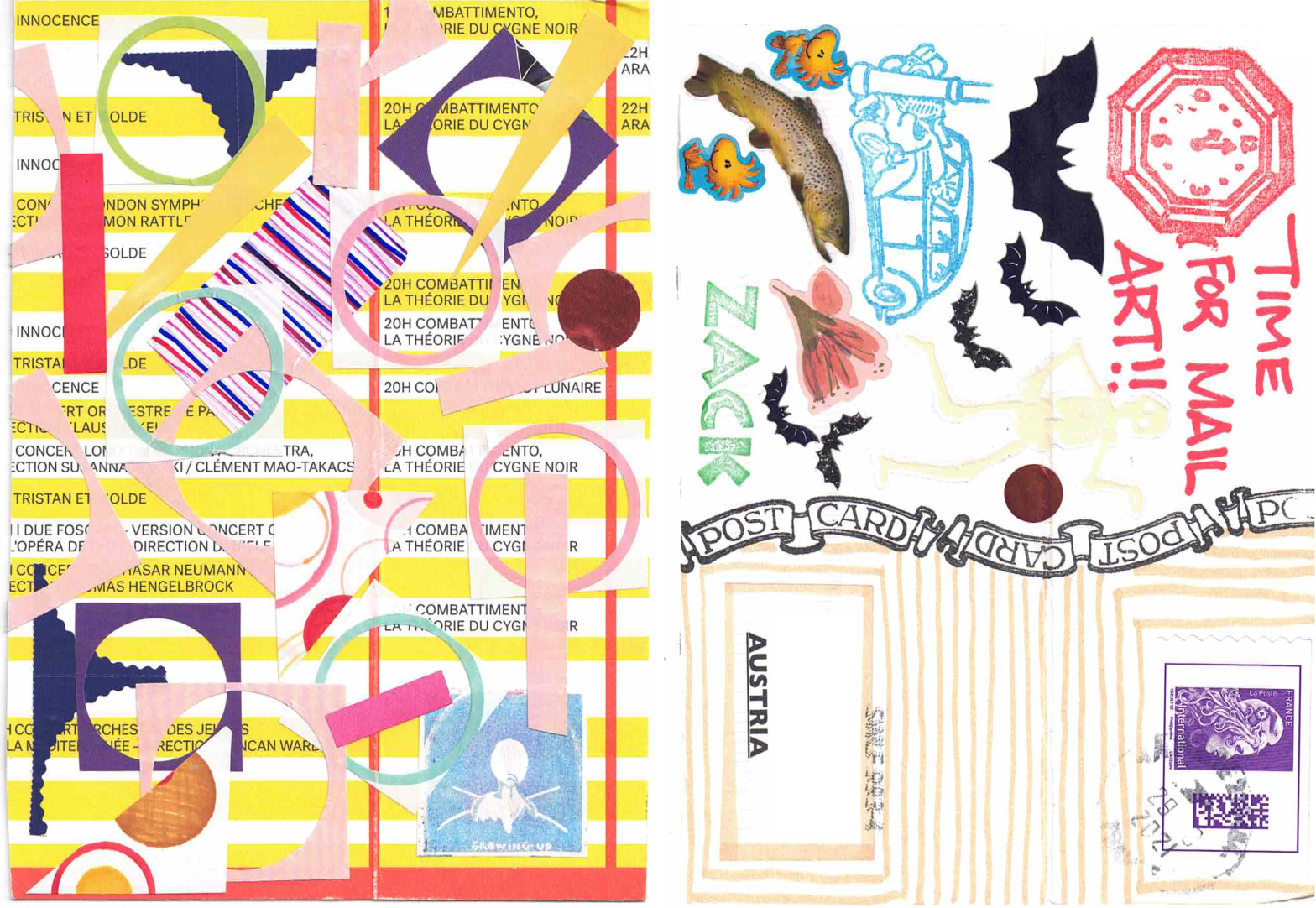
The postcard from the French mail artist Zack leaves much space fore interpretations. E.g., the text on the right side says in Italian and French:
20h combattimento. La théorie du cygne noir.
In English: 20:00 fighting. The theory of the black swan.
Other crumbs of text refer to a young conductor and to the story of Tristan and Iseult which dates to the 12th century and was retold in Richard Wagner’s opera Tristan und Isolde.
When I put all parts of the puzzle together, I think… that maybe I should stop interpreting dadaistic pieces of art.










 mail your art