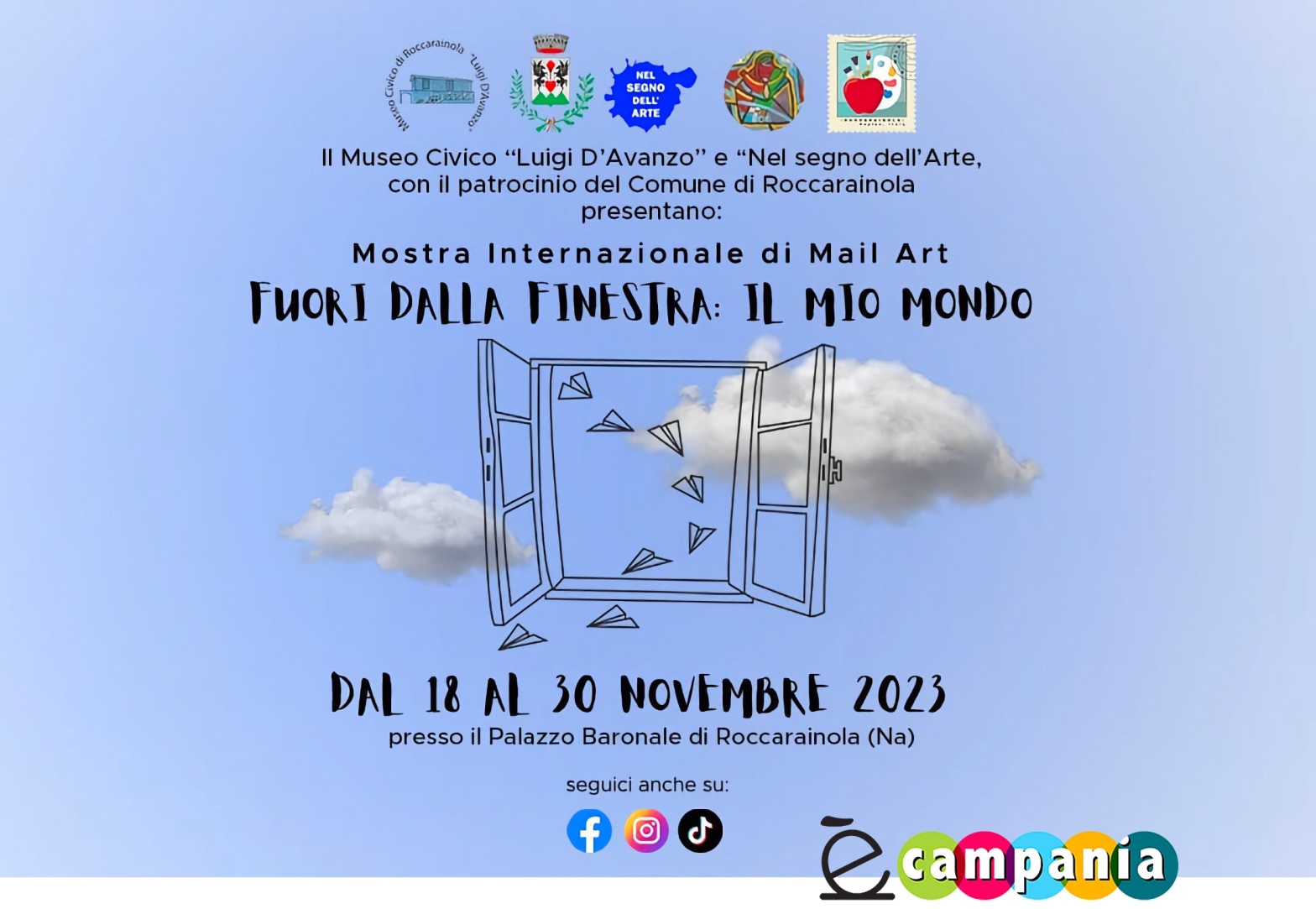
Fuori dalla finestra

Un articolo di è campania

Il mondo visibile e invisibile, oltre alla finestra.. Questo è il tema della mostra internazionale di arte postale organizzata dall’Associazione Nel segno dell’arte di Avellino con il Museo civico Luigi D’Avanzo di Roccarainola. Un percorso espositivo che si articola attraverso opere, rigorosamente 20×20 cm, in cui ciascun artista ha riprodotto le atmosfere e le prospettive del proprio mondo interiore o le luci, le forme e i colori della realtà che lo circonda.

Un esercizio molto utile per raccontare gli scenari del nostro tempo ma anche per scoprire che mondo nuovo può produrre la fantasia e i sentimenti di un artista.

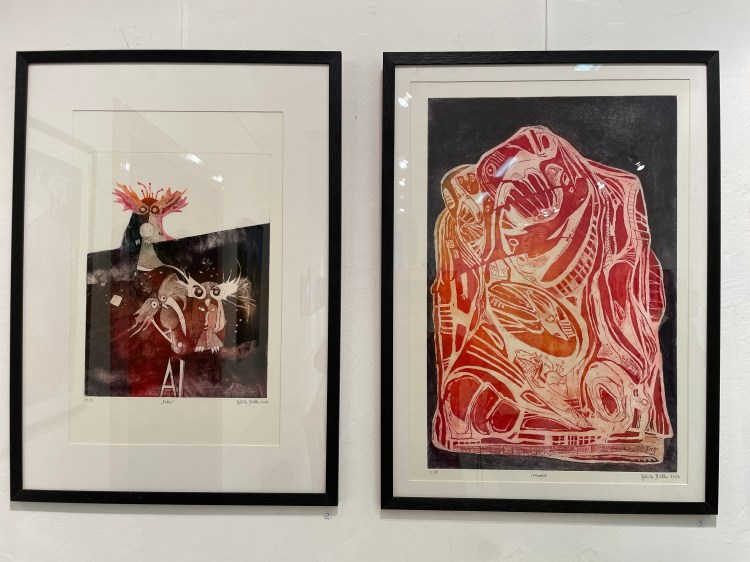
Hanno aderito 250 artisti da 32 nazioni e per la precisione da Argentina, Austria (a destra: l’opera di Gabriele Müller), Bangladesh, Belgio, Bielorussia, Brasile, Canada, Cile, Colombia, Costa Rica, Cuba, Ecuador, El Salvador, Francia, Germania, Giappone, India, Italia, Macedonia, Messico, Paesi Bassi, Paraguay, Polonia, Regno Unito, Russia, Serbia, Spagna, Turchia, Ungheria, Usa, Venezuela.

Attraverso il fenomeno della mail art si espande il concetto di unione da provenienze lontane e diverse facendo dell’arte un modo per accorciare le distanze geografiche, culturali e ideologiche.

La mail art o arte postale è una forma d’arte inventata dall’americano Ray Johnson, che nel 1962 ha dato il via al primo esperimento inviando , tramite posta le sue creazioni in tutto il mondo. Questo movimento è considerato il piu’ democratico poiche’ aperto a chiunque abbia accesso al servizio postale e tutti possono partecipare. Dagli anni sessanta ad oggi la comunita’ di artisti postali è diventata la piu’ numerosa del mondo e hanno permesso alla mail art di diventare il movimento artistico più longevo della storia dell’arte.

La mostra

Sabato 18 novembre alle 18.30 la cerimonia di apertura al palazzo baronale di Roccarainola ( Na ) con gli interventi critici dei curatori Generoso Vella e Raffaella De Stefano alla presenza del Sindaco di Roccarainola Giuseppe Russo, del presidente del consiglio comunale con delega alla cultura Giovanni Sirignano e del Presidente del Museo civico Carmine Centrella.

La mostra è visitabile dal 18 al 30 novembre 2023 su appuntamento dalle 18,00 alle 20.00 con ingresso libero. Per prenotarsi contattare il Museo civico di Roccarainola su Messanger di Facebook.

Partecipanti

Abajkovics Péter – Agar Meral – Agrawal Ram Krishna – Alemanno Ariel – Anil Ayse – Anna Wajda – Aragon Ramírez Maria – AraujoGersilmar – Argiolas Andreina – Aslan Engin – Baña Sabela – Barducci Piero – Batlle Mme Annie – Bayarri Nieves Salvador – BeltrameSilvana – Benedetti Luciana – Benitez Odila – Bergamini Luisa – Bermudez Josefina – Bianchini Lorena – Bicocca Modesto – Bifulco Maria Blanca Lierandi – Blazquez Emilio – Bonifazi Monica – Borocz Haydee – Braglia Marzia – Bucci Rossana – Burcu Kaya Karaduman – Caccavale Alfonso – Caccaro Mirta – Campanini Silla – Capuano Guido – Caro Lucia – Carma – Carré Christiane – Castejon Victor Silva -Castillo Maria – Castro Adriana – Castro Mello Suely – Castro Acosta Freddy Robert – Catanzaro Claudia – Cazzaro Maria Teresa – Chiarello Laura – Clennell Lynette – Colangelo Tiziana – Colombo Carla – Coppola Vittoria – Corina Nani – Corsitto Carmela – Costa Mariella – Cotellessa Giuliano – Coto Karl -Crivellari Antonio – Cruz Eligio Linarez Guedez – Czech Adam – D’Angelo Flora – D’Avanzo Lina – Danicek Renata – De Cesario Giorgio – De Cicco Mario – De Lourdes Endara Maria – De Luca Alessandra – De Marchi Gherini Antonio – De Riggi Maria – De Santiago Enrique – De Stefani Adolfina – De Stefano Raffaella – Dell’Aquila Ciro – Della Monica Kodama TeresaCristina – Delle Donne Carmen – Di Pardo Carla – Divoto Christian – Diaz Johanna – Durán Trinidad – Dutta Annie – Farina Cinzia – FavaroLara – Fergnachino Margherita – Feruglio Claudio • Figueroa Debora – Fiore Silvana – Furia Marco- Galassi Ivo – Garces Elizabeth -Gancie Rosalie – García Torres Rosa – Gauvry Floki – Gentili Dania – Giunta Graziana – Gociol Raquel – Gonzales Mendez Domingo – Gorgulu Eren – Grazyella (Graziella Di Grezia) – Guadalupe Romero -_Guroga – Höfig Uwe- landolo Benedetta -lovino Ilaria- ImbrognoRosy – Jeamzol (Sanabria Sanchez Alfredo) – Jimenez Miguel – Karla Martinex – Keppler Roberto – Krolikowska-Pataraia Katarzyna -Krstevski Ztlatko – La Casiniere Nicolas – La Toan Vinh – Lamadrid Felipe – Lanfranco Eugenio – Larbre Annie – Leal Angelica – Le Grottaglie Fulvio – Lei Anni – Leona K – Lipp Karla – Liuzzi Oronzo – Lierandi Blanca – Loera Olga – Loreau Virginie – Luciano Patrizia – Luigetti Serse – Mabi Col – Maggi Ruggero – Mailarta – Mandarik Katerina – Manganiello Antonio – Manuel Xio Blanco – Maretto Anna Maria – Martell Rebeca – Maris Velasco Stella – Marrali Calogero – Martinez Maribel – Marzullo Gerardo – MayoMichelangelo – Megazzini Paolo – Merone Nunzia – Merletti Liliana – Meza Malvis – Milazzo Tina – Minedi Gabi – Minichini Angela – Miseljic Jasmina – Misuzugaoka Midori – Monica Elisa – Morales Carlos Fernando – Morales Rebeca – Morosseleta Lesh – Müller Gabriele – Murillo Rochi – Nakamura Keiichi – Napolitano Celeste – Natale Federico – Navarro Cortez Ignacio – Navghare Jeeja – Nikbakht Rahman – Noah Serafino – Novikova Irina – Olmeda Melita – Olivera Carmen L. – Orrigo Maria Caterina – Ortelli Oscar – Panizzolo Patrizia -Pantano Marcelo Ariel – Pasquillo Vittoria – Pavolucci Fabrizio – Pecoraro Rosella Rosa – Pepe Chiara – Perez Nilda – Perillo Tiziana – Petrillo Fiorenzo – Pierozzi Bruno – Pintus Laura – Piroska Norvath -Pozzi Paine’ Veronique – Quijada Edrin -Racconi Diego -Radovanovic Mirjana – Ramos Lazaga Carlos Miguel – Repiccioli Paola – Repillosa Sadih – Riccio Serena – Rigolli Milena – Rivas Cepeda Katty – Rizzo Rosana Irene – Rivero De Chea Yulenny Gloribeth – Rodriguez Oswaldo – Rosenberger Marcia – Rossi Lucia – Rossi Rosario- Rosso Stefania – Rumee Ruhul Karim – Ruotolo Barbara – Salanitro Enzo – Sánchez Sánchez Magaly – Sánchez Vergara Mónica – Sala Eleonora – Sarmirnto Laura – Scala Roberto – Schiuma Alberto – Schumacher Lars – Schumacher Susanne – Secondulfo Giovanna – Serafino Cesare – Serafino Noah – Severino Domenico – Snappy – Soria Irma – Speciale Fiorentina – Spence Michael – Spina Rosa – Stevanovic Ljiliana- Strada Giovanni – Strada Renata – Strollo Michela – Tammaro Antida – Terzi Eva – Tilli Mariarosaria – Tino Vincenzo – Traverso Elisa – Tress Horst – Valerian Mzia – Vallario Anna Maria – Varricchio Francesco – Vasiljevic Jasmina Mima – Vázquez Eduardo – Vecchio Giovanna – Vella Lina – Vella Generoso – Verna Giovanni – Verstegen Joland – Vesovic Dragana – Vezquez Griselda M – Villarroel Miriam – Vittadello Antonia-Volosiuk Svetlana – Warren Simon – Zanatta Maria Esther – Zuliani Roberto – Zurita Hada e gli allievi della 3A della scuola media S.Croce di Magliano (CB ): Alessandra F. – Francesca B.- Francesco F.- Giuseppe F. – Nicola C. – Luigi G.- Tony I.- Nicolas D.S. – ManilaC.- Giovanni P. – Michela A.- Maria Z. – Majda J. – Luigi Antonio M. – Rosa L. e Piervincenzo D.P.

(articolo © ecampania.it)
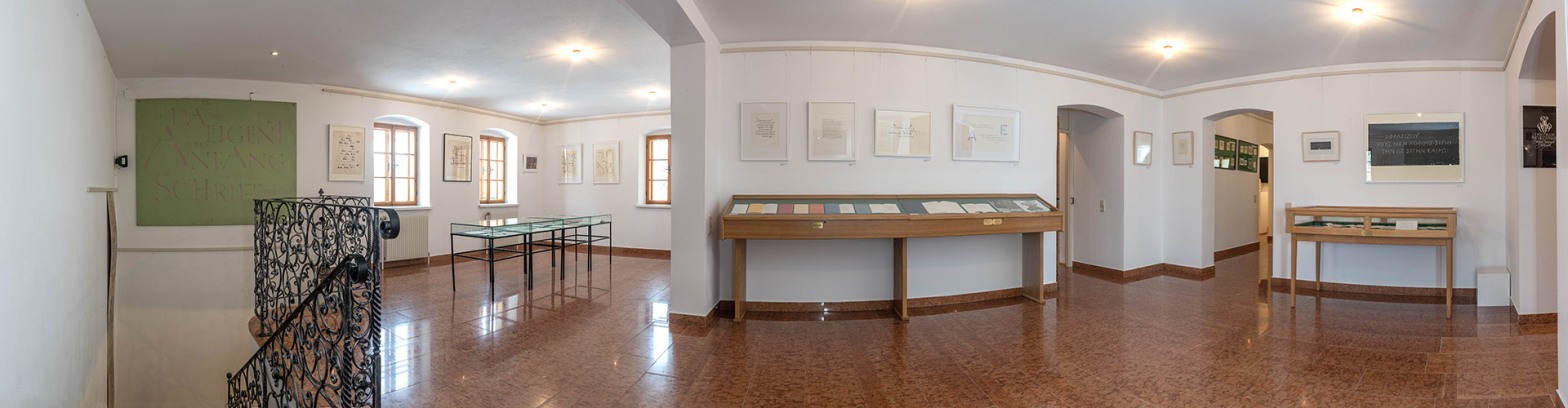
Mail Art im Schriftmuseum

Das Bartlhaus, Österreichs einziges Museum, das sich der Schriftkunst widmet, ruft Mailartisten und -artistinnen zur Einsendung einer Karte im Format A6 auf, Thema und Technik sind frei.

Die eingesendeten Arbeiten werden in der temporären Galerie TEMPO gezeigt. Auch Karten, die ein paar Tage nach Eröffnung der Ausstellung am 27. April eintreffen, haben noch Chancen auf Publikum. Bis zum Ende der Präsentation am 27. Oktober werden die Einsendungen laufend ergänzt und aktualisiert.

Im 1992 gegründeten Bartlhaus im oberösterreichischen Prettenbach werden neben Schrift in Form von Kalligrafie und Druck auch Exlibris in wechselnden Ausstellungen präsentiert. Letzteres sind künstlerisch gestaltete kleine Druckgrafiken oder Stempel, die als Eigentumsnachweis in Bücher eingeklebt wurden.

Ausschreibung

Ein partizipatives Ausstellungsprojekt greift auf das Genre der Mail Art zurück, Kunst, die mit der Post verschickt wird. Alle Interessierten sind eingeladen, eine Karte an das Bartlhaus zu schreiben und sich dadurch mit einer Kulturtechnik auseinander zu setzten, die dabei ist, aus unserer Gesellschaft zu verschwinden.

  • Erlaubt sind alle Techniken der Mailart: Schreiben, Stempeln, Kleben, Malen, Zeichnen.
  • Postkarten im Format A6 (10,5 x 14,9 cm)
  • per Post an:
    Schriftmuseum Bartlhaus, Museumstraße 16, 4643 Pettenbach, Österreich
  • Bitte den vollständigen Absender  angeben (Name, Adresse, Land)
  • Nach den üblichen Regeln der Mailart werden alle Einsendungen gesammelt, dokumentiert und ausgestellt: keine Jury, keine Kosten, keine Rückgabe
  • Karten mit verletzenden oder diskriminierenden Inhalten werden vom Projekt ausgeschlossen
  • Mit der Einreichung ihres Beitrags stimmen alle Künstler:innen den Teilnahmebedingungen zu und autorisieren den Veranstalter zur honorarfreien Veröffentlichung, Verbreitung und Abbildung ihres Werkes für Berichterstattung und Öffentlichkeitsarbeit. Sie versichern, dass die Urheberrechte des Werkes bei ihnen liegen und es keine Vereinbarungen mit Dritten gibt, die daraus Nutzungsrechte geltend machen können.
  • Wie bei Mail-Art Projekten üblich, verbleiben die eingesendeten Werke beim Veranstalter.
  • Bitte geben Sie die Information weiter! Wir freuen uns über viele Zusendungen, die in unserer temporären Galerie TEMPO ausgestellt werden.

Ab 27. April 2024 besteht für Besucher:innen im Museum die Möglichkeit, Karten aus dem Museum zu verschicken.

Call

A participatory exhibition project draws on the genre of mail art, art that is sent by mail. All interested people are invited to write a card to the Bartlhaus and thereby engage with a cultural technique that is in the process of disappearing from our society.

  • All mail art techniques are allowed: writing, stamping, gluing, painting, drawing.
  • Postcards in A6 format (10,5 x 14,9 cm)
  • send by mail to:
    Schriftmuseum Bartlhaus, Museumstraße 16, 4643 Pettenbach, Austria
  • Please indicate the complete sender (name, address, country)
  • According to the usual rules of mail art all submissions will be collected, documented and exhibited: no Jury, no Fee, no Return
  • Cards with offensive or discriminatory content will be excluded from the project
  • By submitting their entry, all artists agree to the terms and conditions of participation and authorize the organizer to publish, distribute, and image their work for reporting and public relations purposes free of charge. They assure that they own the copyrights of the work and that there are no agreements with third parties who can claim rights of use.
  • As usual with Mail-Art projects, the submitted works remain with the organizer.
  • Please pass on this information! We look forward to receiving many submissions that will be exhibited in our temporary gallery TEMPO.

Starting on April 27, 2024, visitors of the museum will have the opportunity to send cards from the exhibition.

Links

[Photo: © Bartlhaus]

Un tributo merecido

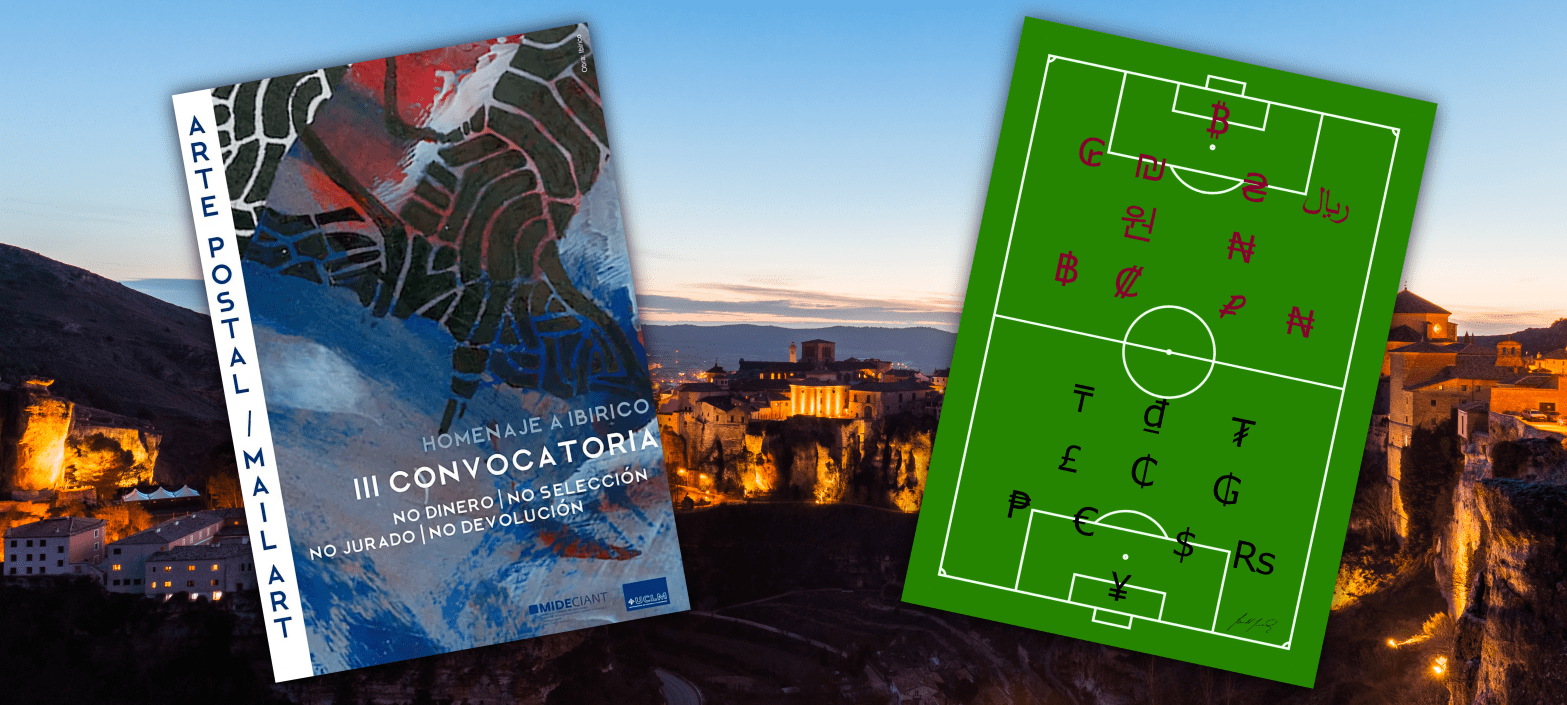
Ibirico fue uno de los artistas más activos de arte correo en España. Rendirle tributo fue el tema de la III convocatoria del Museo Internacional de Electrografía (MIDECIANT) y de la Universidad de Castilla-La Mancha (UCLM).

En la exposición en homenaje a Ibirico, se muestran las obras de más de doscientas personas de todo el mundo. En la muestra, comisariada por Ana Navarrete y Montserrat de Pablo, se puede ver también una selección de la creación del propio Ibirico. Además, se exponen los fanzines de la Asociación de Mail Artistas Españoles (AMAE) que había fundado el homenajeado.

Todas las 362 obras enviadas, procedentes de 27 países, ya se pueden ver en el primer folleto. La contribución de Gerald Jatzek se orienta en el humor subversivo de Ibirico. En una cancha de futbol, el mail artista austriaco sustituye los jugadores por los símbolos de diferentes monedas. Estas juegan el papel verdadero en este juego de los adultos.

Exposición

III. convocatoria arte postal del MIDECIANT: Homenaje a Ibirico,
Sala Acua Cuenca, UCLM, del 26 de octubre al 26 de noviembre de 2023

Links

Sobre Ibirico

Video realizado por Maya López Muro – Studio de Arte Il Graffiacielo – San Giovanni Valdarno, Arezzo, Italia

[Fotografía de Cuenca: Diego Dielso CC-BY-SA]

Spanish Jazz & Signs in Spain

Jazzándaluz is an offspring of the International Festival of Music, Theatre and Dance of Priego de Córdoba, which has been around for more than 75 years. It is an event where the best musicians and bands of Spain get together. The organizers call it a “commitment to quality culture made in our country”.

Since 2019 an exhibition of mail art, curated by Manuel Molina González and José Luis Campal from Córdoba, forms part of the festival. Campal characterizes arte postal as “conceptual and idealistic” and draws parallels with the experimental character of avant-garde jazz music.

The illustration shows the festival poster and Gerald Jatzek’s postcard which combines the beauty of the Alhambra and a contemporary trumpet in a jigsaw that can never be solved, because it changes with every interaction between tradition and improvisation.

Interventions

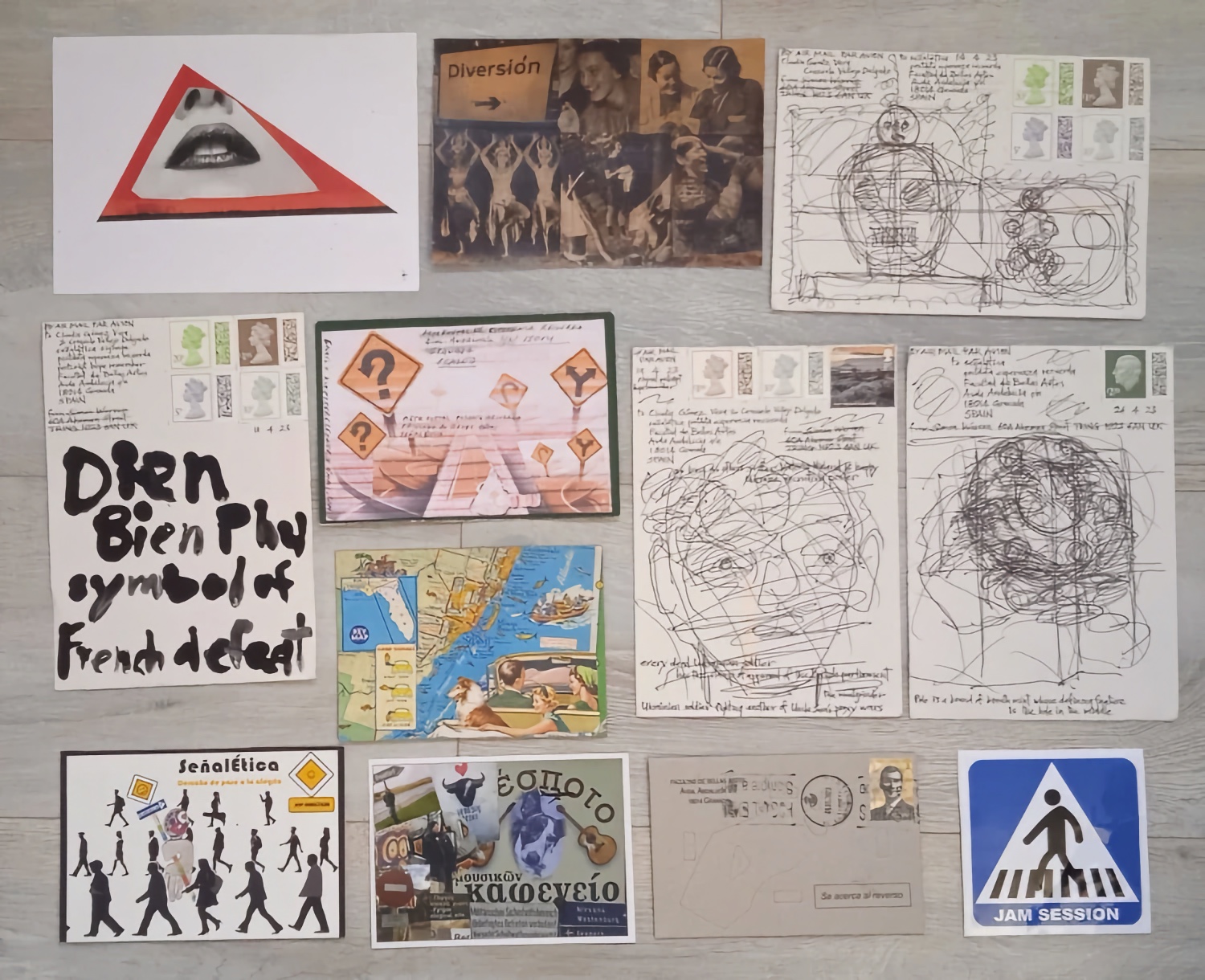
Postdata Esperanza Recuerda was a mail art project by the Facultad de Bellas Artes of the Universidad de Granada. They were looking for images of public signs with interventions for a collection called senalÉtica.

Illustration 1: Works by Fátima Jiménez Puertas (Spain), Rebecca Choate (Spain), Simon Warren (Great Britain), Leonor Kierzberg (Argentina), Tofu (USA), Ramaulart, Gianni Ramacciotti (Italy), Gerald Jatzek (Austria, bottom row, second from the left) Patri Díez (Spain), Ivan Albalate (Spain)
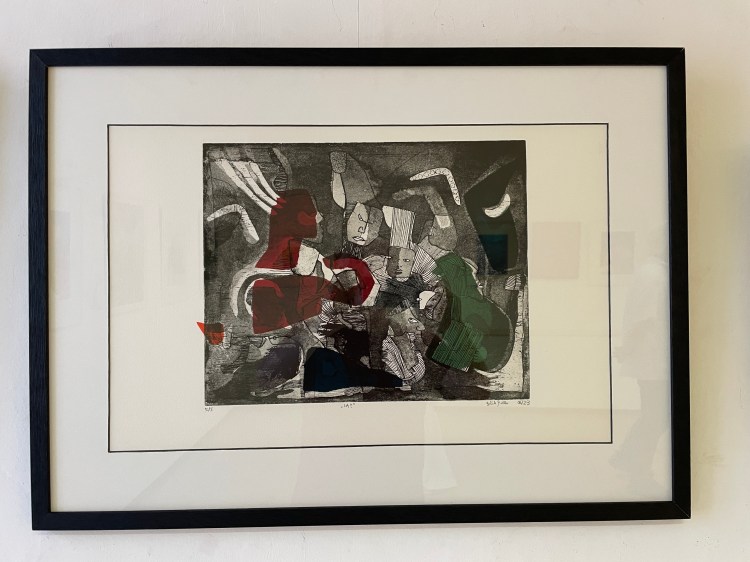
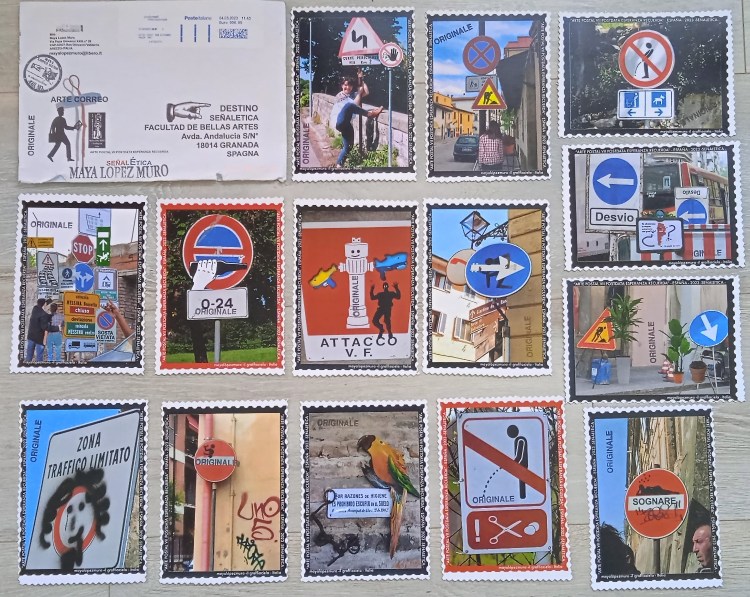
Stamps by Maya Lopez Muro

Illustration 2: A great collection of stamps designed by the well-known mail artist Maya López Muro.

Außergewöhnliches aus Köln

Die Kölner Parasitenpresse ist einer der interessantesten Verlage Deutschlands, nicht zuletzt aufgrund der Anthologien mit Texten aus Dänemark, Griechenland oder Lettland. In der Zeitschrift Etcetera Nr. 93 erschienen zwei Besprechungen aktueller Bände.

Poetische Vielfalt

Adrian Kasnitz ist zunächst einmal Brückenbauer. Mit der Parasitenpresse stellt er übersetzte Lyrik aus zahlreichen Kulturen vor, darunter auch aus sogenannten kleinen Sprachen wie Albanisch, Birmanisch, Dänisch, Griechisch oder Lettisch. Mit dem Wissen um eine Vielfalt an Traditionen und Stilen entscheidet sich Kasnitz bei den eigenen Gedichten in vielen Fällen für eine an lyrische Prosa angenäherte Form.

Nicht wenige Texte gehen im Sinne Charles Olsons vom Autor, respektive seinem lyrischen Ich aus: “Weil ich keinen Kaffee hatte, geh ich nicht ans Telefon / wenn du anrufst und von Berlin erzählst, der Hype ist doch / längst vorbei (…)”, beginnt ein Text rund um den Morgen eines Verlegers.

Dabei findet der Autor freilich in surrealistischer Tradition poetische Wörter und kombiniert sie mit Slapstick- Einlagen: “Habe mir Reis aufgehäuft und Fleischbällchen dir / versuche meiner Tochter zu erklären, was ein Oxymoron sei / ein Wort in der Nachbarschaft und Okapi / er wohnt im fernsten Ozean, den noch niemand entdeckt / habe mit Fleischbällchen dich hast mit Reis mich beworfen (…)”

In Texten, in denen Rhythmus und Melodie stärkere Bedeutung haben, finden sich lakonische Formulierungen, die – vermutlich seit Leonidas – das beste Mittel gegen Pathos darstellen: “In die südliche Stadt kommen die Leute / aus dem Winter, fassen sich an die Brust (…) dann kommen sie langsam auf dumme Gedanken / und schauen den Einheimischen hinterher”.

Der Band hat freilich noch viel mehr zu bieten, was hier nur aufgezählt werden kann: das – selbstverständlich gebrochene – Naturgedicht, die Reflexion der Lyrik auf sich selbst, parodistische Anklänge an Liebesgedichte inklusive und das vorauseilende Epitaph für Insassen der Intensivstation Instagram. Wobei viele Texte andere Sichtweisen erlauben als meine. Denn: “Jeder hat eigene / Interessen in einem Traum”.

Adrian Kasnitz: Im Sommer hatte ich eine Umarmung, Parasitenpresse, Köln 2023, 90 S., ISBN: 978-3-988050-09-0

Gerald Jatzek

Von unten

Vorausgeschickt sei im Sinn der Transparenz, dass ich mich Köln und besonders seinen weniger begüterten Bewohnern seit den frühen 1970ern verbunden fühle. Da war ich in der Stadt einige Zeit als Straßenmusiklehrling, angeleitet von ansäßigen Helden des Genres wie Fliege und Klaus dem Geiger.

Rolf Heinrich, Köln – Creative Commons 3.0

Was wir damals oft nebenbei an Geschichten zu hören bekamen, ist der Stoff, aus dem Alexander Estis seine Miniaturen über das Veedel (Grätzl) Kalk formt. Er hat dort urbane Legenden gesammelt, eine Gattung, die wie Märchen gemeinsamen Ängsten, Wünschen und Träumen entspringt; C.G. Jung würde sagen: dem kollektiven Unterbewussten. Im ersten Text bringt dieses eine Frau ohne Augen und Nase hervor, die trotzdem alles beobachtet, eine Erfahrung, die jeder nachvollziehen kann, der Wiener Wohnungen mit Rückspiegeln an den Fenstern kennt. Solche Geschichten aus dem Weichbild der Wirklichkeit können auch witzig sein, wenn es etwa um türkische TV-Sendungen geht, deren Ton durch Rohrleitungen in alle Wohnungen eines Hauses übertragen wird.

Immer wieder dringt freilich der naturalistische Hintergrund durch. Vergewaltigung, Prostitution, Drogen, Altersarmut. Dem muss man sich stellen: “Wenn der Mann noch einmal meine Töchter anguckt, dann schneide ich ihm mit dem Fischmesser den Penis ab.” (S. 54).

In der Ära überschwappender Soaps wirken die Protagonisten dieser Texte seltsam gelassen, wenn sie täglichen Ärgernissen und existiellen Problemen ohne Pathos und oft selbstironisch begegnen. Vermutlich verfügen Drama Kings und Queens über Energie, die viele Menschen in Quartieren wie Kalk brauchen, um nicht in die Gräben zwischen Einkommen und Miete oder zwischen Leistung und Gesundheit zu fallen.

Der Autor erzählt Alltagsgeschichte und Skurrilitäten, Tragisches und Weggetretenes, Romantisches und Kriminelles, weshalb es schade ist, dass es nach kanpp 90 Seiten schon zu Ende ist.

Alexander Estis: Legenden aus Kalk. Nach Erzählungen der Menschen
eines Kölner Veedels, Parasitenpresse, Köln 2023, 94 Seiten, ISBN: 978-3-947676-81-1

Gerald Jatzek

Skepticism

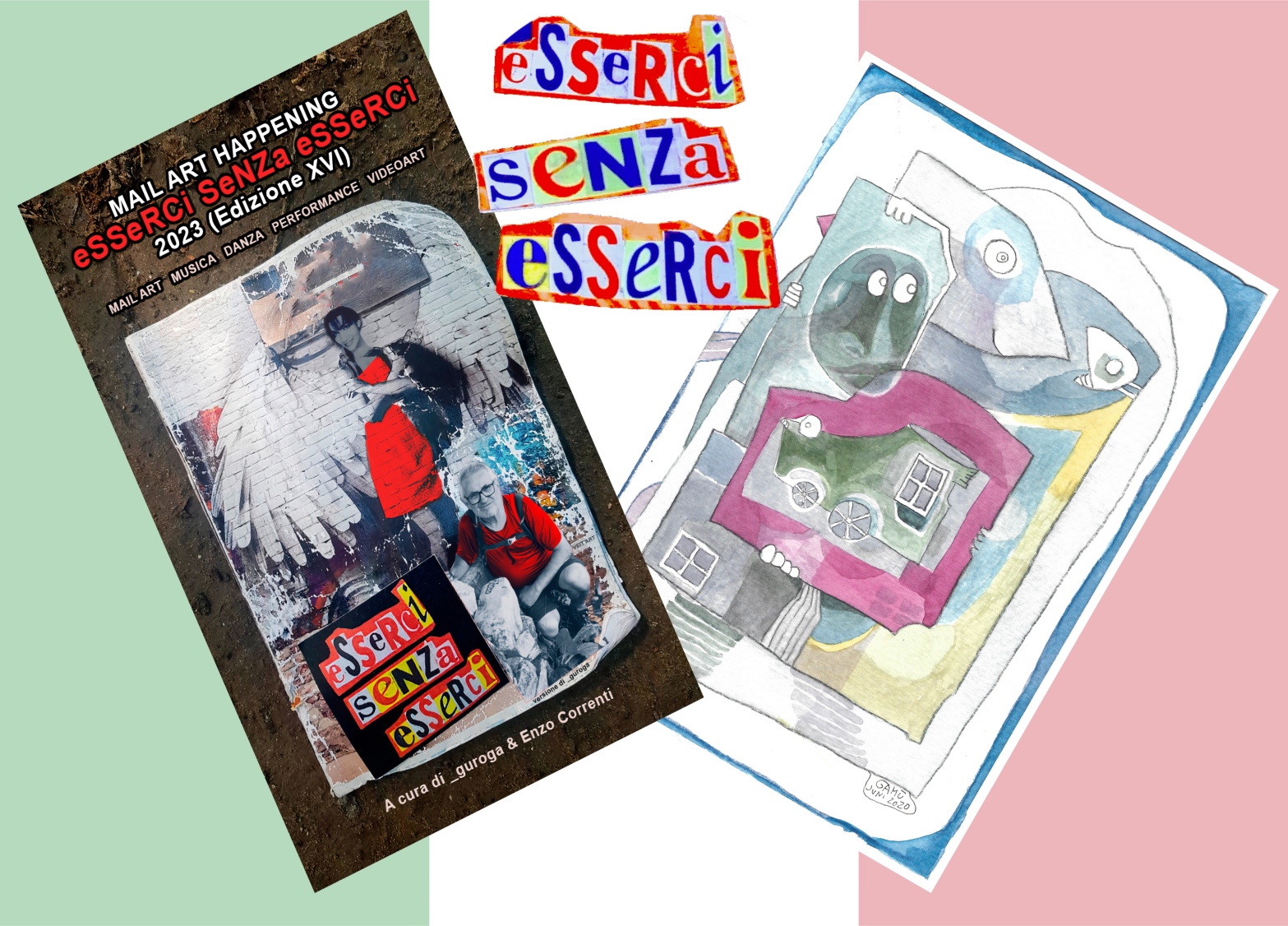
The mail art exhibition esserci senza esserci has a tradition that dates back to the year 2008. This year 196 artists from 22 countries reacted to the call.

The exhibition was curated by _guroga and Enzo Correnti and supported by the Collettivo Dada Boom Viareggio and the Collettivo Superazione Viareggio. The show took place at the gallery Spazio 43 in the town of Prato in Tuscany, Italy.

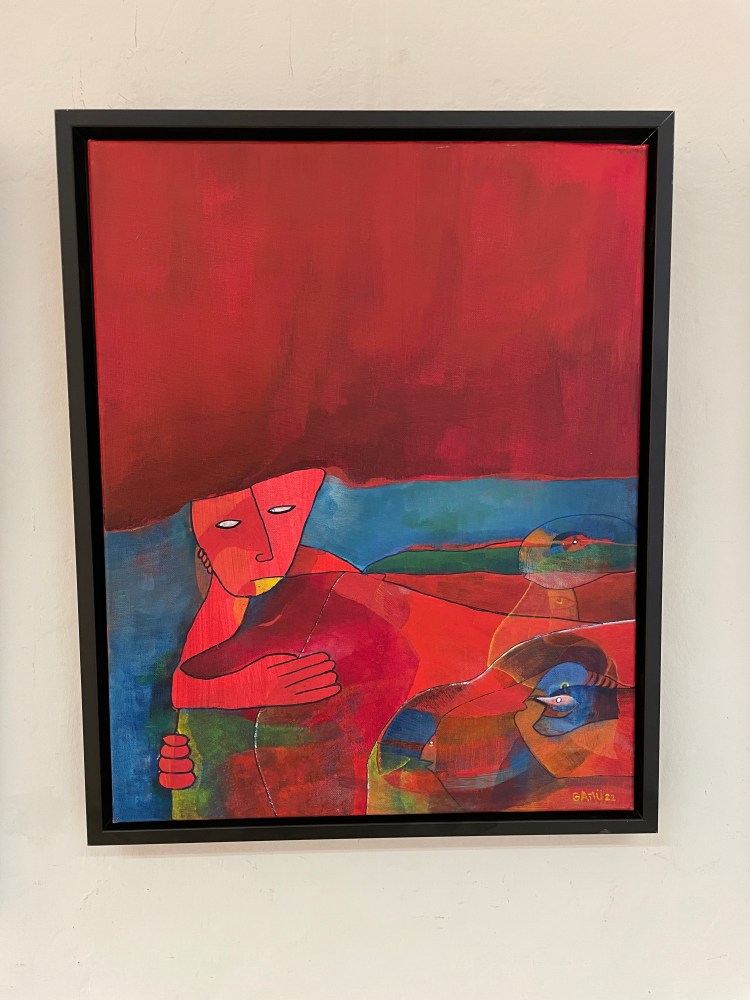
On the right side of the illustration you can see Gabriele Müller’s painting escepticismo (skepticism or scetticismo, resp.).

Artists

The participants of the exhibition

Links

Peace in Brazil

Paz na terra or Peace on Earth is the title of an exhibition in Jundiaí, a town in the state of São Paulo, located 57 kilometres north of São Paulo.

The exhibition presents drawings, photographies, paintings, collages, ink drawings, watercolor paintings and prints.

The works come from artists from Spain, Estonia, USA, Belgium, Japan, Germany, Canada, Malaysia, Austria, Norway, Uruguay, Croatia, Belarus, England, Greece, Italy, Hungary, Czech Republic, Poland, Romania, Mexico, France, Colombia, Belarus, Switzerland, Argentina, Lithuania, Netherlands, Taiwan, Denmark and Brazil.

Peace Card by Gerald Jatzek
Peace Card by Gerald Jatzek (2023)

Gerald Jatzek’s contribution user important artifacts to illustrate the capabilities of mankind – which obviously don’t include the ability to maintain peace on earth.

The Exhibition

Paz / Peace
organized by Marco Antonio Scarelli and the Associação dos Artistas Plásticos de Jundiaí
Galeria Edros, Jundiaí, Sao Paolo, Brasilien
29.9.-31.10.2023

Links

Wirklich unwirklich

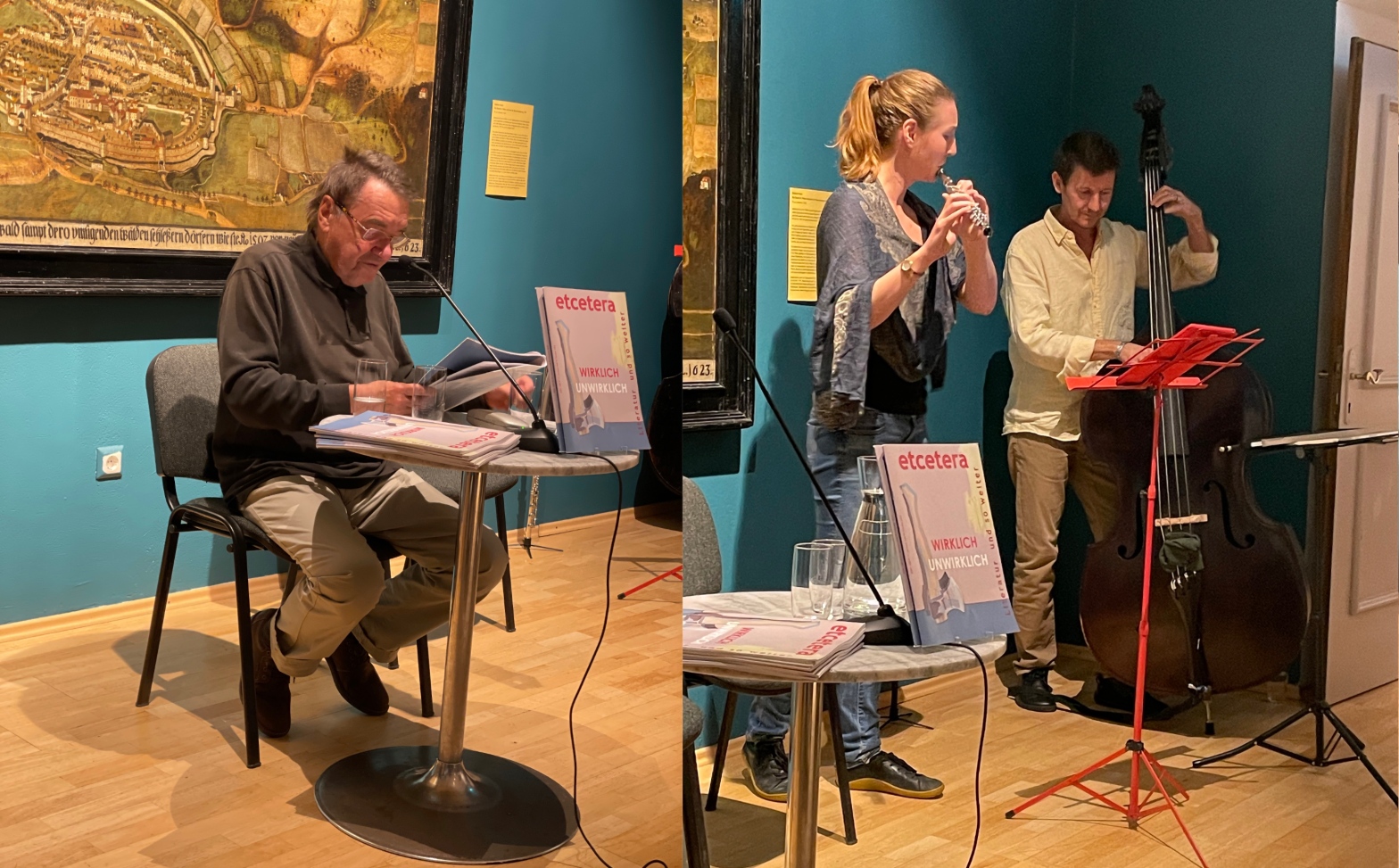
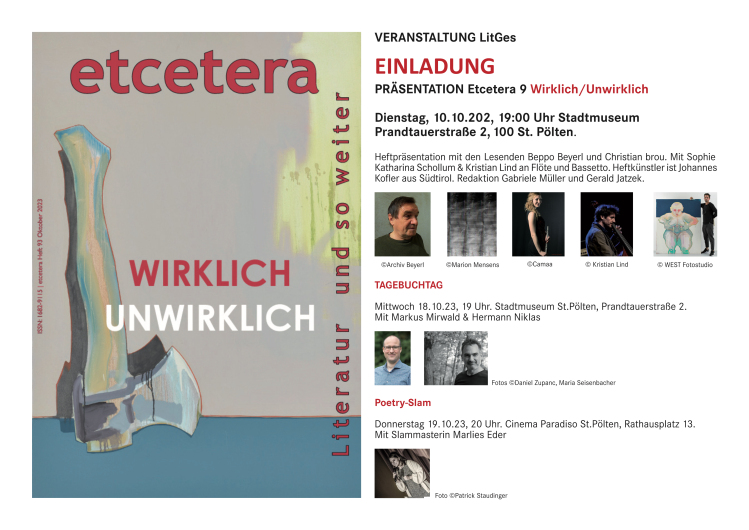
Am 10.10. wurde die Nummer 93 der niederösterreichischen Kulturzeitschrift etcetera, die von der Literarischen Gesellschaft St. Pölten herausgegeben wird, im Stadtmuseum vorgestellt.

Beppo Beyerl (oben links) las seine Dokumentation einer Hexenverbrennung, und Christian Orou trug eine skurrile Fantasystory von Thomas Gobbele sowie aphoristische Prosa von Jutta Treiber vor. Eva Riebler präsentierte die bildnerischen Arbeiten Johannes Koflers .

Für die Musik sorgten Sophie Katharina Schollum (Flöte, Gesang) & Christian Lind (Kontrabass) mit originellen Eigenkompositionen. Am Ende erhielten sie einen verdienten Sonderapplaus.

Reale Illusionen

Die Redaktion bildeten diesmal Gerald Jatzek und Gabriele Müller, die das vielfältig interpretierbare Thema wirklich – unwirklich vorgaben, das historischen Fanatismus, aktuelle Hirngespinste und Science Fiction ebenso umfasst wie die Auseinandersetzung mit Großmeistern der literarischen Phantastik wie Borges und Kafka. Dazu kommt ein Interview mit dem Herausgeber von Das Gedicht, Anton G. Leitner.

Die beiden arbeiteten sich durch mehr als 300 Texte und hätten gerne mehr veröffentlicht. Allein, der maximale Umfang war erreicht, mehr können die Heftklammern nicht zusammenhalten.

Die Anordnung der Texte und die Kombination mit Bildern von Johannes Kofler hat in bewährter Manier Gerhard Axmann übernommen.

etcetera Nr. 93

  • Texte von Egyd Gstättner, Friedrich Hahn, Joachim Gunter Hammer, Marián Hatala, Christina Hermann, Hahnrei Wolf Käfer, Peter Tertinegg, Lukas Leinweber, Christoph Mandl, Leopold Federmaier, Susanne Kos, Jutta Treiber, Manfred Ach, Walter Baco, Rudolf Kraus, Karl Drechsler-Mörwald, Nora Beiteke, Beppo Beyerl, Georg Biron, Gudrun Breyer, Manfred Chobot, Oliver Fahn, Thomas Gobbele, Roland Grohs, Ulf Großmann, Anke Hagemann, Annabel Herkströter, Sandra Humer, Ingo Kieslich, Richard Oppong, Anita C. Schaub, Silke Andrea Schuemmer, Tárkány Szücs Réka, Tim Tensfeld, F. A. Tomasi, Adrian van Schwamen, Florian Waldner, Giuseppe Corbino und Janko Ferk.
  • Interviews mit Johannes Kofler und Anton G. Leitner.
  • Besprechungen von Büchern von Alexander Estis, Eleonore Weber, Margit Mössmer, Camille Viéville, Adrian Kasnitz, Peter Becher, Milena Michiko Flašar, Friedrich Zwickl und Konstantin Kaiser.

New Poems in Canada and the USA

Nature is not good or bad, not ugly or beautiful, not weak or strong. Nature is, and nature is sometimes hard to understand.

This is where poetry comes in. “What can be explained is not poetry”, wrote the great Irish poet William Butler Yeats in a note to his son.

However, poetry can explain the world. Usually it doesn’t use the tools of rationality, but empathy, intuitition, associativity, musicality and more.

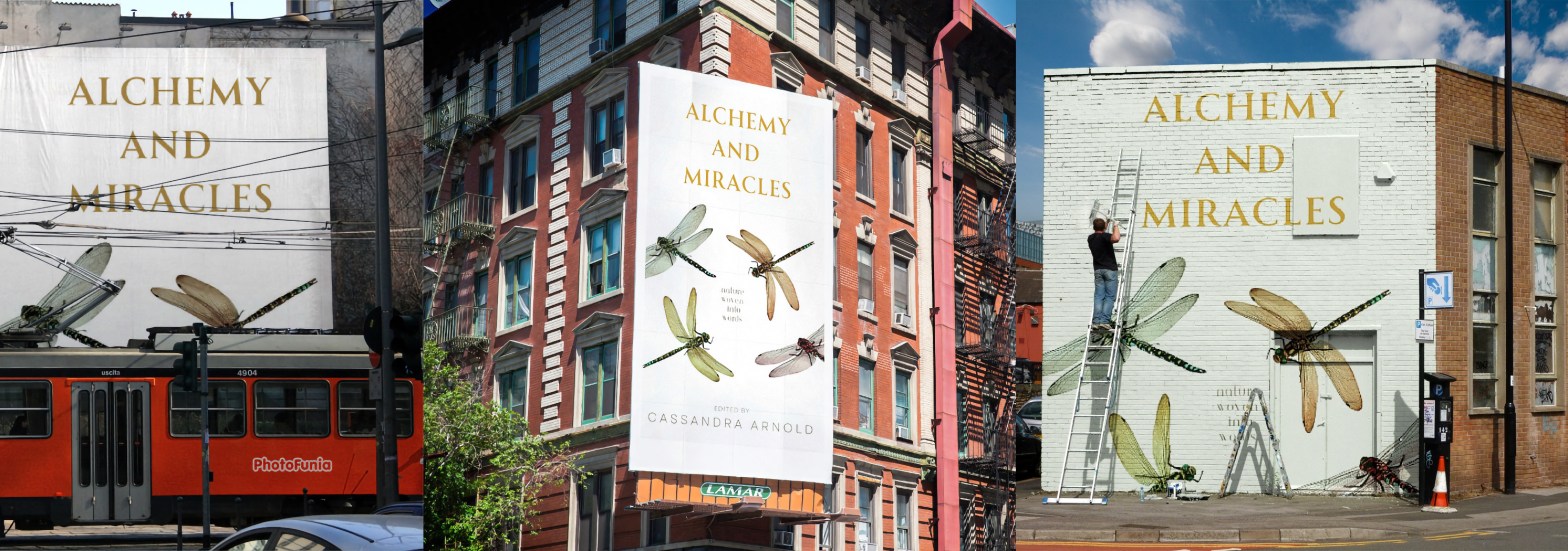
Cassandra Arnold, a writer and painter, collected works from more than 80 international poets that “weave the miracles of nature into words”. Among them are Gerald Jatzek’s three poems based on the actor–network theory (ANT). Wikipedia’s defines the ANT as a “theoretical and methodological approach to social theory where everything in the social and natural worlds exists in constantly shifting networks of relationships.”

But fear not, my readers. They are nonetheless as poetic as it can get.

Cassandra Arnold (ed.): Alchemy and Miracles – Nature woven into words, Gilbert and Hall Press, Calgary, Canada 2023

Poems online

Two more of Gerald’s poems were published on the website of David O’Nan’s US-based magazine Fevers of the Mind.

Time Flies

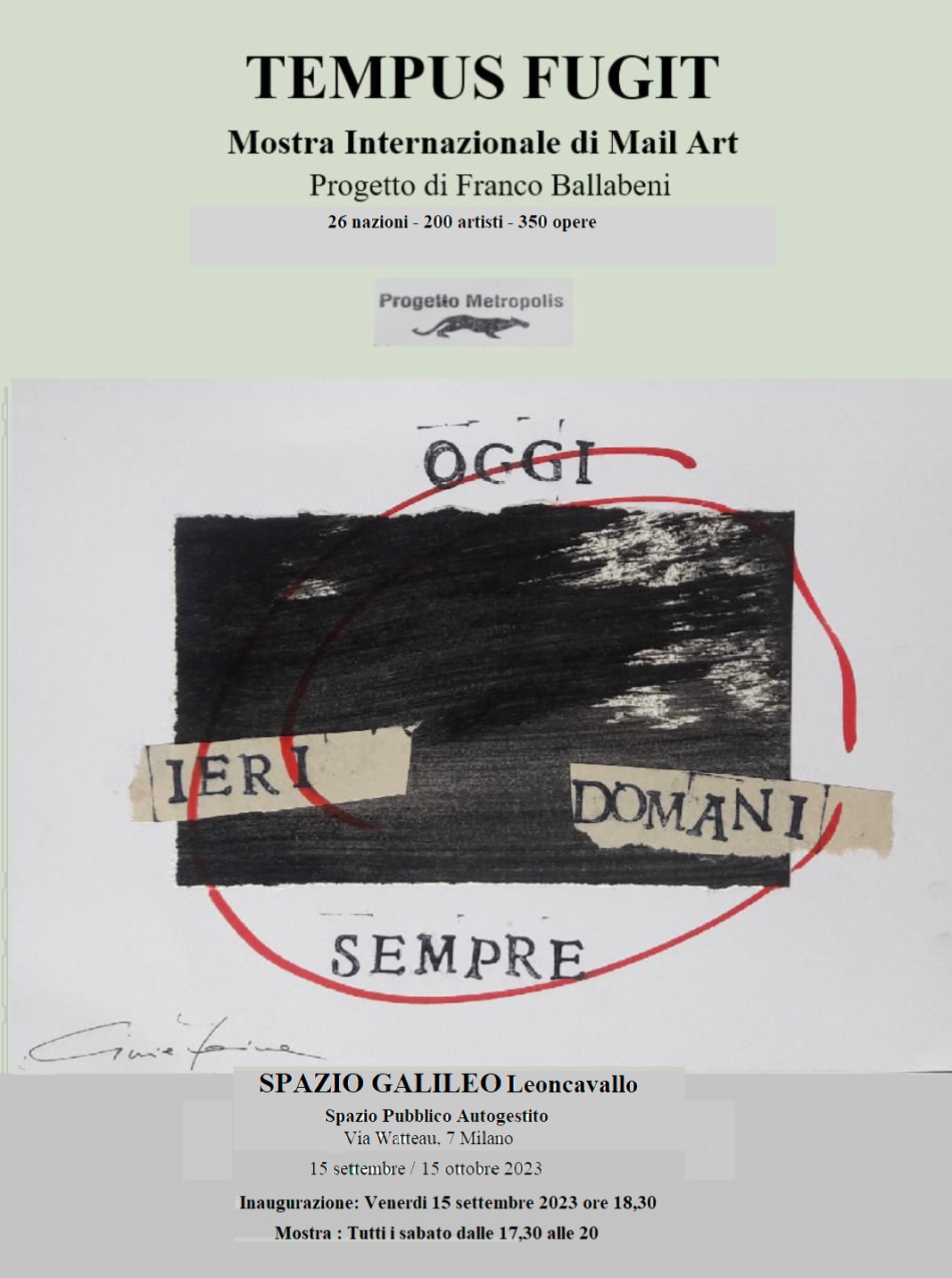
Franco Ballabeni called, and 200 artists sent 350 works on the theme tempus fugit (time flies). They formed an exhibition that was first shown in Colico, a town situated on the northern arm of Lake Como in the Italian province Lombardy.

The Mostra Internazionale di Mail Art took place in the Museo della Cultura Contadina in Colico (Como) between 6 May and 10 June 2023.

In July 2023 the works were shown once more; this time in the municipality Rivarolo Mantovano, located about 110 kilometres southeast of Milan. The exhibition took place in the prestigous Palazzo del Bue.

Right now, you can visit the mail art collection at the Spazio Galileo which is a part of the Centro Leoncavallo in Via Antoine Watteau 7 in Milan.

The center is a self-managed social place, which exists since a former factory on via Leoncavallo was squatted in 1975

A relaxed Life

The characters in Gabriele Müller’s sketch don’t seem to take the aphorism carpe diem (seize the day) too serious. Some are discussing matters, others seem to wait for something that happens once in a blue moon. Only the bird-workers are busy, yet, they don’t seem to work in tight time frames either.


Geschichte der Farben

Diese kompakte Darstellung beginnt bei den Erdfarben der Höhlenmalerei und endet mit der Farbnormierung im Druckwesen und in der in der Informationstechnologie. Dazwischen führt die Kunsthistorikerin Camille Viéville durch dreißig weitere, für die Farbe in der Kunst wichtige Perioden. 

Etwa die Vielfarbigkeit im Ägypten der Pharaonen, wo es keinen Begriff gab, der unserem Blau entspräche, die Farbstrenge der Reformation oder die Erfindung der Ölmalerei. “Die Gesellschaft ‘macht’ die Farbe, sie definiert sie und gibt ihr Sinn, stellt ihre Bedeutungen und Wertigkeit her, wendet sie praktisch an und klärt zentrale Fragen rund um die Farbe“, wird der Mediävist Michel Pastoureau zitiert, der in den 1980er Jahren durch seine Arbeiten das Interesse der Historiker am Thema Farbe weckte. 

Durch eine Auswahl an wichtigen, mitunter von der Kunstgeschichte vernachlässigten Werken beleuchtet die Autorin, wie sehr die Konzeption und Wahrnehmung von Farbe in jeder Epoche, jeder Kultur und Kunstrichtung variieren. Man erfährt über den Widerstreit zwischen Zeichnung und Malerei, und wie Farben den Geschlechtern zugeschrieben wurden. Die elektrische Beleuchtung führte zu neuen Sichtweisen. Vieles kann aufgrund der Umfangsbeschränkung nur gestreift werden.

Geschichte der Farben

Bis auf einen Exkurs über das indische Holi-Fest und die Bedeutung des Schattens in Japan konzentriert sich Camille Viéville auf den westlichen Raum.

Nicht nur die Farbe als solche, auch ihre Anordnung findet Erwähnung. So war in der römischen Antike und im Mittelalter gestreifte Kleidung ein Attribut der niederen Kasse. Der Wechsel zwischen den Farben bedeutete Unordnung, Unruhe und Unreinheit. Das beschrieb Randgruppen wie Narren oder Häftlinge. 

Wer einen Einblick in Geschichte, Symbolik, aber auch in Materialien und Techniken der Farbanwendung gewinnen möchte, ist mit dem Buch gut beraten.

Camille Viéville: Eine kurze Geschichte der Farbe, Berlin: Laurence King Verlag 2023, 224 S., Aus dem Englischen von Gisa Roudil d’Ajoux-Hillebrand. ISBN: 9782080279361

(Die Druckfassung ist in der Zeitschrift etcetera Nr. 93 erschienen.)

Foto: Gerd Eichmann – CC 4.0 / Wikimedia Commons

Una obra colaborativa

“La poesía visual es parte de un campo mucho más amplio que genéricamente denominamos poesía experimental.
No existe fórmula que permita determinar claramente si una obra puede o no ser considerada Poesía Visual. El borde es difuso.
Síntesis entre imagen y palabra, juego entre signos y formas y otras lecturas posibles.
Todos los recursos son válidos, la creatividad desafía los límites y los tensa tanto como la imaginación permita.
Entre el riesgo de cortar la cuerda por un lado o permanecer a resguardo en un lugar seguro, la Poesía Visual habilita un espacio de libertad que necesita ser explorado.”

Con estas palabras, Rosa Gravino, coordinadora de la convocatoria abierta  poesia visual – libro-objeto colaborativo , inicia el catálogo de la exposición en el Museo de Arte Cañadense, Cañada de Gomez, Argentina.

El texto lleva a la práctica uno de los principios de arte correo: no son los galeristas, los compradores y los teóricos los que juzgan, sino cada uno puede decidir qué es y qué no es arte.

El collage a la derecha es la contribución de Gerald Jatzek, la fe, que confronta el Sermón de la montaña con la realidad del Santo Oficio de la Inquisición.

Links

Créditos

Las fotos de la inauguración provienen del catálogo.

Artistas participantes

Almandrade Andrade (Brasil), Luis María Labrador (España), Juan Fran Nüñez Parreño (España), Samuel Montalvetti (Argentina), Víctor Valqui Vidal (Perú), Adam Blackshaw (Australia), Oronzo Liuzz (Italia), Sabine Remy (Alemania), Alfonso Aguado Ortuño (España), Péter Abajkovics (Hungría), József Bíró (Hungría), Mirta Caccaro (Italia), La Toan Vinh (Canadá), Adriano Necci (Italia), Tchello D’Barros (Brasil), Claudio Gavina (Italia), Alejandro Thornton (Argentina), Keiichi Nakamura (Japón), Giovanni Fontana (Italia), Serse Luigetti (Italia), Bruno Chiarlone (Italia), Domenico Severino (Italia), John Bennett (USA), Piotr Szreniawski (Polonia), Ana Suárez (Argentina), Pinçon Christian (Francia), Nico Vasilakis (USA), Corina Nani (Rumania), OmarOmar (Argentina), Pier Roberto Bassi (Italia), Constança Lucas (Brasil), Armando Parvool Nuño (México), Raimon Blu (España), Katerina Nikoltsou (Grecia), Rubén Sassano (Argentina), Fábio di Ojuara (Brasil), Irene Ronchetti (Argentina), Emiliano Ortega Rousset (México), Gianluigi Balsebre (Italia), Mauro Dal Fior (Italia), Débora Daich (Argentina), Jaime Rguez (España), Angela Caporaso (Italia), Adriana Lucaciu (Rumania), Emma Pedreira (España), Viviana Andrada (Argentina), Emilio Blázquez Domenech (EMILYO) (España), Alison Keenan (Canadá) Marcela Pera (lArgentina), Ignacio Navarro Cortez (México), Laura Rivera (Argentina), Alejadra Bocquel (Argentina), Hilda Paz (Argentina), Charlotte Jung (Suecia), Miguel pA. Mercader (Argentina), André Robèr (Francia), Paco Pérez Belda (España), Maya López Muro (Italia) Hugo Pontes (Brasil), Guijarro (México), Fabio Doctorovich (Argentina), Orlando Pelichotti (Argentina), Bernardo Morales González (V1XWAL) (México), Francesco Aprile (Italia), Elson Fróes (Brasil), Walter Brovia (Argentina), Silvia Lissa (Argentina), Moisés Robles (México), Josep Sou (España), Osvaldo Miguel Morales Barraza (Chile), Claudio Mangifesta (Argentina), Maria Paz Fernandez (Argentina), Marco Furia (Italia), Sergio Bonzón (Argentina), Paula Doberti (Argentina), Sibara (México), Sabela Baña (España), Omar Moreno (Colombia), Elsa Dommarco (Argentina), Ender Rodríguez (Venezuela), Ptrzia (TICTAC) Cacciaguerra (Alemania), Francesc Xavier Forés (España), María Angélica Carter Morales (Argentina, María Castillo (Argentina), Rosalie Gancie (USA), José Alberto Martínez Villegas (Pepe Rappdem) (México), Marcelo Bagnati (Argentina), Franklin Valverde (Brasil), C. Mehrl Bennett (USA), Mario José Cervantes (Colombia), Nono Zilahi (Rumania), Luc Fierens (Bélgica), Alejandra Koreck (Argentina) Miguel Jiménez – El Taller de Zenón (España), Norberto José Martínez (Argentina), Néstor Rossi (Argentina), Persefone (México), Fabio Di Ojuara (Venezuela), Calber (España), María Zanatta Ferreyros (USA), Diego Axel Lazcano (Argentina), Michelangelo Mayo (USA), Natacha Dulon (Argentina), Lucía Caro (Argentina), Calixto Saucedo (Argentina), Iara Abreu (Brasil), Claudio Gentile (Argentina), Angelcarmelo (España), Giangrazio Verna (Italia), Martín Vega (Argentina), María Jimena Alvarez (Argentina), Raquel Gociol (Argentina), Laura Pintus (Italia), Alexander Limarev (Rusia), Cinzia Farina (Italia), Idalia López Garza (México), Ana Perrotta (Argentina), Victoria Beltrán (México), Atiliano Sevillano (España), Tereza Yamashita (Brasil), _Guroga (Venezuela), Marcia Rosenberger (Brasil), Las esmeraldas (Argentina), Colectivo Veir Art (Italia-Venezuela), Enzo Correnti (Italia), Hércules Trigo (Brasil), Tulio Restrepo (Colombia), Ina Ripari (Italia), Mariano Lo Gerfo (Italia), Valeria Zabala (Argentina), Vlado Goreski (Eslovenia), Makis Moulos (España), Claudio Romeo (Italia), Daniel Acosta (Argentina), Floki Gauvry (Argentina), Eliso Ignacio Silva (Venezuela), Stella Maris Velasco (Argentina), Leonty Kostur 1947 (Ucrania), Alejandra Coirini (Argentina), Lola González (UK), Claudia Catanzaro (Argentina), Leodan Morales (México), Ana Pobo Castañer (España), Cælina March (Francia), Maribel Martínez (Argentina), Amelia Figueira (Argentina), Debora Figueroa (Argentina), Fred van Welie (Paises Bajos), María Eugenia Díaz (Argentina), Alberto Blanco (Argentina), Luis Martín Castañeda Morfín (México), Erika Vera López (México), Rosana Villarino (Argentina), Manuel Calvarro Sándhez (España), Carla Colombo (Italia), Janys Oliveira (Brasil), Jésica Frustaci (Argentina), Paulo Teles (Portugal), Lamberto Caravita (Italia), Christophe Massé (Francia), Luis Gomes (Portugal), Claudia García (Argentina), Kara Ponce (Perú), Faustino Gutiérrez Pérez (México), Gerald Jatzek (Austria), Aireandomee (Argentina), Diego Díaz (Argentina), Eugenia Elena Riemschneider (Rumania), Edilberto Sierra Rodríquez (Colombia), Julieta Potaschner (Argentina), Adriana Antequera (Venezuela), Angélica Leal (Venezuela), Ismael Fernando Ortiz Castro (Argentina), Priscilla Ramos (Brasil), María Eugenia Quiroga (Argentina), Diana Magallón (México), Thais Oliveira da Rosa (Brasil), Jorge Maximo Vela Damonte (Perú), Rebeca Dorich (Perú), Anna Flávia Schmitt Wyse Baranski (Brasil), Rosana Schmitt (Brasil)

Lots of Yellow and Orange

A watercolor painting and a spontanous Taffy poem: They were sent to the British artists Kevin & James Gillen. The envelope shows a koala and some exotic lizards, accompanied by the text not in Austria, a reference to the common confusion of Austria and Australia.

Un aniversario muy triste

Exposiciones de mail art en diferentes Universidades de la ciudad de Antofagasta

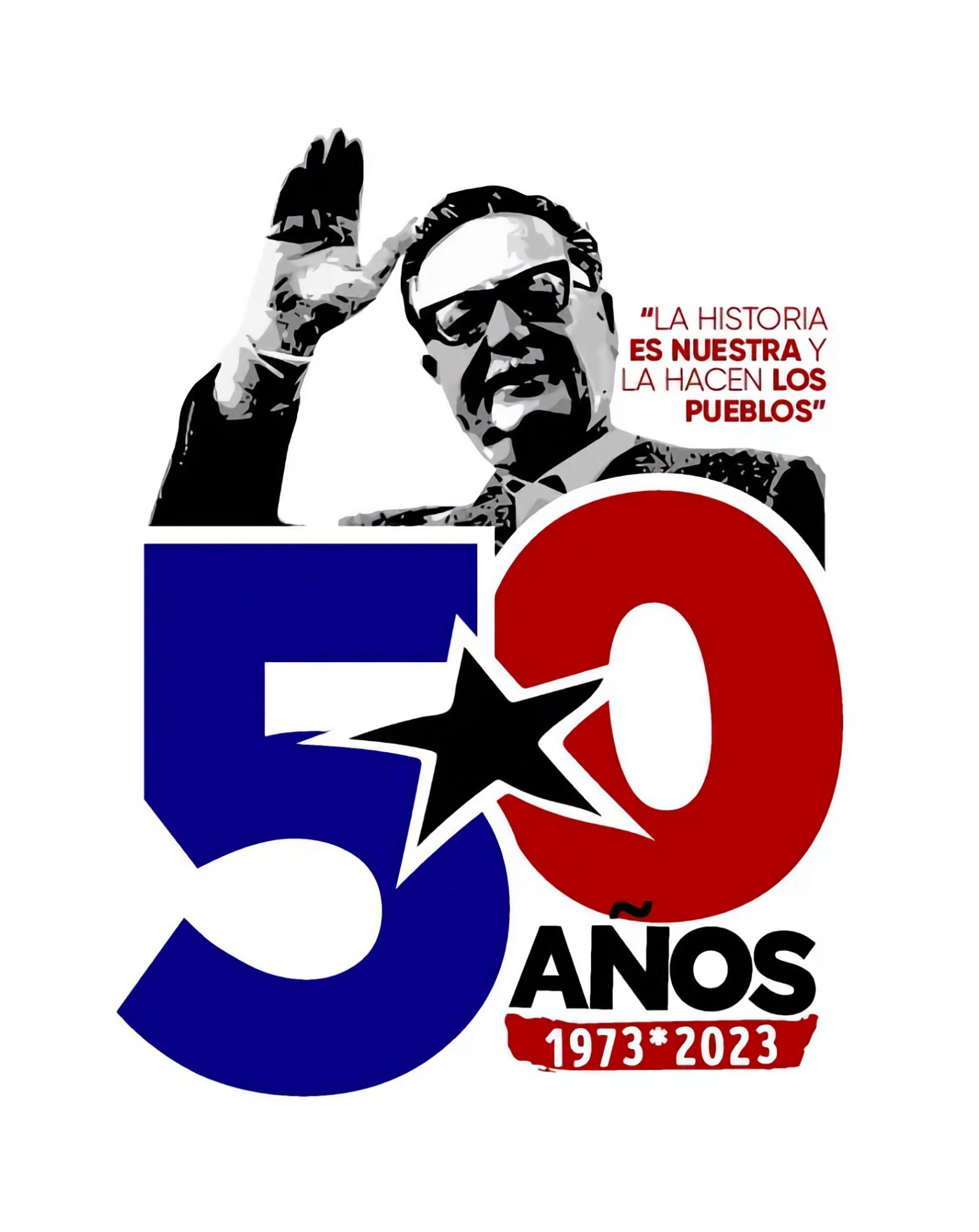
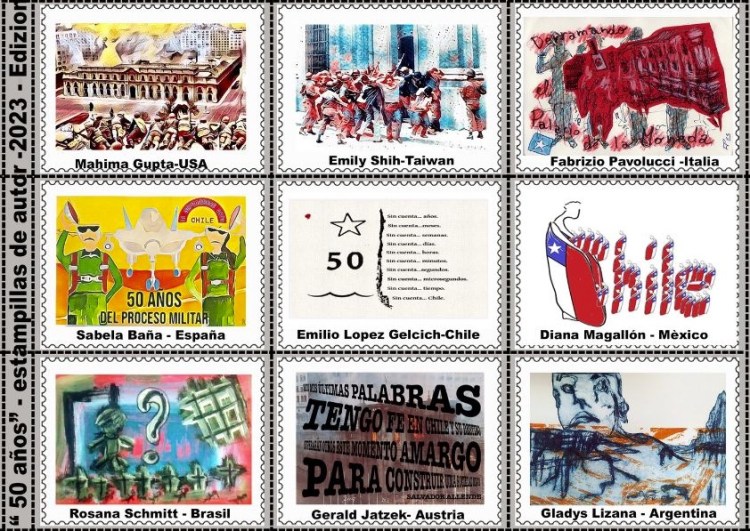
El 11 de septiembre mucha gente en Europa recuerda los atentados que ocurrieron el mismo día en el año 2001. Pero para la América Latina democrática esta fecha es relacionada dolorosamente con el 11 de septiembre de 1973. Maya López Muro y Rogelio Cerda organizaron una convocatoria de arte postal como homenaje a quienes perdieron la vida en ese momento histórico.

Ese día tropas chilenas, mandadas por generales fascistas y apoyadas por los EEUU, derrocaron con bombas al gobierno democráticamente electo del presidente Salvador Allende.

El golpe fue planificado con gran antelación. El cerebro del plan fue el ministro de Asuntos Exteriores de los EEUU, Henry Kissinger.

Ya tres años antes había encargado el asesinato del comandante en jefe del Ejército chileno, René Schneider (1913-1970), por su apego al orden constitucional y el respeto por las elecciones democráticas.

Sin embargo, también su sucesor Carlos Prats (1915-1974) se adhirió a la Doctrina Schneider, rechazando la intervención de las Fuerzas Armadas en los asuntos de gobierno. En el 1974 fue asesinado por la junta chilena en su exilio argentino junto a su esposa, Sofia Cuthbert.

América Latina como colonia

Igual como en Vietnam, también en América Latina el gobierno estadounidense se arrogó el derecho de desestimar la voluntad ciudadana en las elecciones e instituir a dictadores. Así lo hizo en Brasil (1964), Argentina (1966), Perú (1968) y Bolivia (1969), sustituyendo a los gobiernos electos por dictadores.

En los tres años que duró el gobierno de Salvador Allende su plan de acción, sintetizado en 40 medidas, logró considerables mejoras para el pueblo chileno, sobre todo en las áreas de salud, educación y cultura. Pero el partido neo-fascista Patria y Libertad y los EEUU bajo el presidente Richard Nixon y el ministro Kissinger hicieron todo para desestabilizar la Unidad Popular, desde huelgas de transporte, escaseces artificiales hasta ataques terroristas.

El 11 de septiembre de 1973, los militares terminaron con un golpe de Estado el gobierno democráticamente electo. Los EEUU les apoyaron  con dinero, armas y consejos estratégicos. Salvador Allende rechazó el exilio y prefirió morir como presidente de su país.

Con el golpe de Estado se instauró una política estatal dirigida a exterminar a los opositores políticos a través de los más perversos métodos, que se materializaron en prisión política, tortura, ejecuciones, desaparición forzada y despidos laborales masivos. De acuerdo a las distintas Comisiones de Verdad, la cifra total de víctimas ascendió a más de 40 mil personas. Más de 200 mil personas se fueron al exilio durante la dictadura militar.

En los siguientes 17 años de la dictadura militar se reestructuró la economía según las ideas neoliberales de los “Chicago Boys”. Las privatizaciones y el grave empeoramiento de los derechos laborales condujeron a una enorme desigualdad social.

Exhibición en YouTube

Documentaciones en tres idiomas

Español

English

Deutsch

Libros

Pilar Aguilera et al.: The Other September 11, Ocean Press, London 2002

Ascanio Cavallo, Margarita Serrano: Golpe, 11 de septiembre, Santiago  2013, Uqbar Editores, ISBN: 978-956-9171-24-6

Christian Cwik, Hans-Joachim König, Stefan Rinke (Hrsg.) Diktaturen in Lateinamerika im Zeitalter des Kalten Krieges, wbg Academic, Darmstadt 2022, ISBN Online: 978-3-534-27445-1 (kostenlos als PDF bei der FU Berlin)

Peter Kornbluh: The Pinochet File: A Declassified Dossier on Atrocity and Accountability, The New Press, New York 2003 / 2013, ISBN: 978-1-59558-912-5

Armando Uribe: El Libro Negro de la Intervención Norteamericana en Chile: Siglo XXI Editores, Coyoacán, Mexico 1974, ISBN: 978-9-68230-701-0
Armando Uribe: The Black Book of American Intervention in Chile, Beacon Press, Boston 1974

Exposición itinerante

El material recibido formará parte del Archivo del Museo de la Providencia para La Memoria de Antofagasta (Chile). La Muestra será itinerante en diferentes Universidades y sedes de juntas vecinales de la ciudad de Antofagasta.

Se realizará un Catálogo virtual con todos los participantes, entre ellos Gerald Jatzek, quien elaboró el postal en la parte superior de esta página.

Links

Solo in Krems bis 6. Oktober

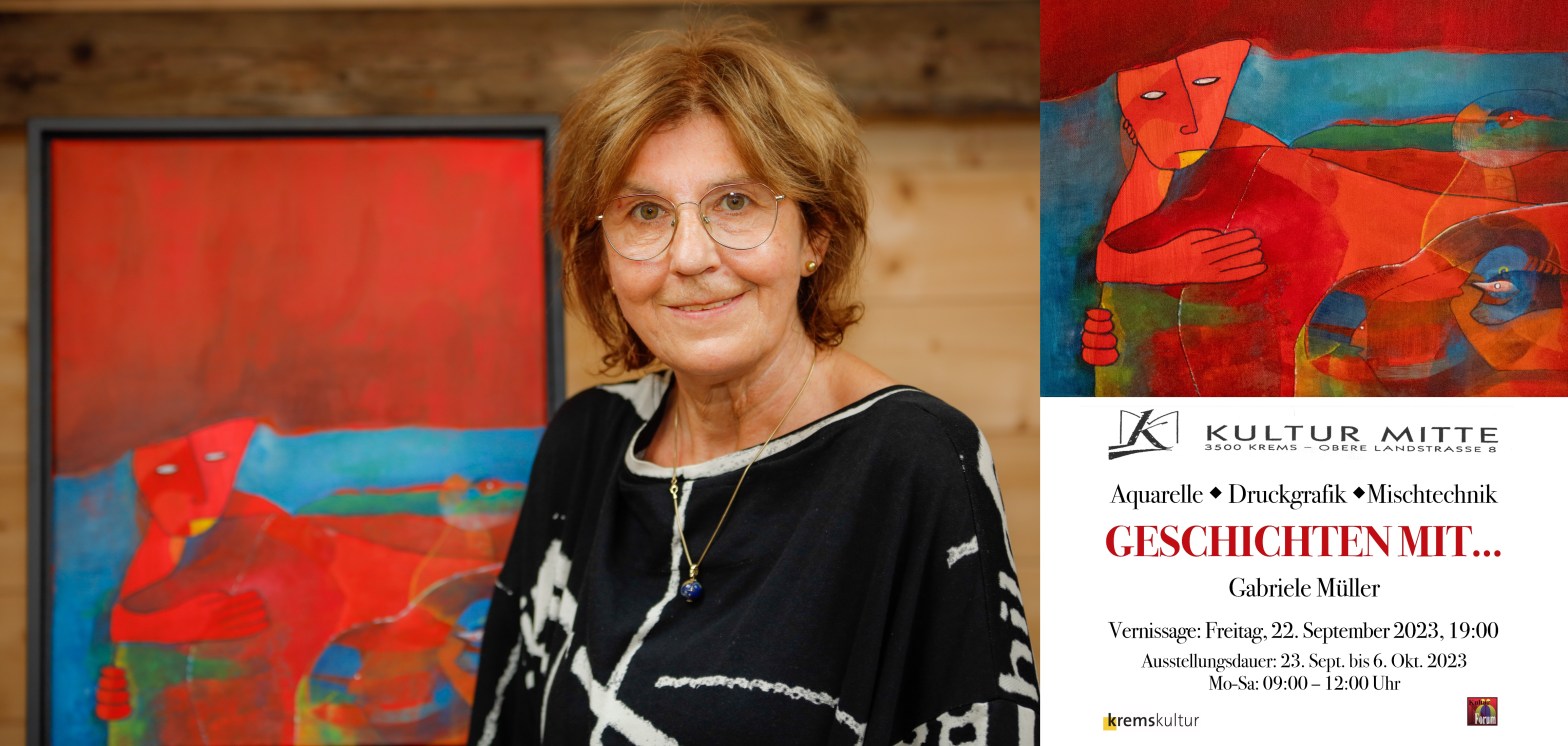
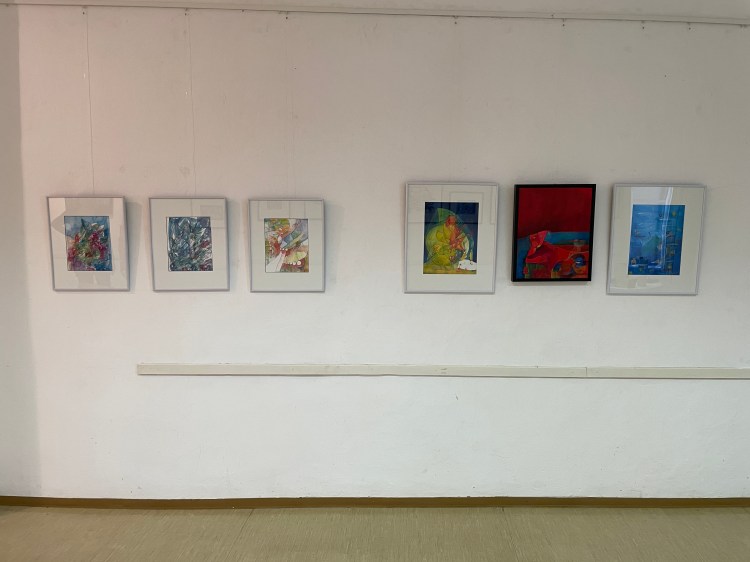
Am 22. September eröffnete der Kremser Bürgermeister Reinhard Resch die erste Soloausstellung Gabriele Müllers in der Kremser Galerie KULTUR Mitte. Der Titel Geschichten mit … verweist einerseits auf das erzählerische Element in den Werken, andererseits auf die Umsetzung mit einer Vielzahl von künstlerischen Verfahrensweisen.

Hausherr Wolfgang Mahrer begrüßte das Publikum, und Christina Hermann arbeitete mit ihren einführenden Worten das Gemeinsame der bildlich umgesetzten Geschichten mit den Texten der Künstlerin heraus. Zwischen den Reden trug Gerald Jatzek internationale Folksongs vor.

Gabriele Müller: Geschichten mit …

Galerie Kultur Mitte, Landstraße 8, 1. Stock, Krems a.d. Donau, geöffnet: 23.9.-6.10., 9-12 Uhr und nach telefonischer Vereinbarung unter +43 676 4554305.

Nachweis: Das Foto im Kopf der Seite stammt von Rolf Wilms.

Die Zeit

Peter Hömseder ist Lehrer an der Blankenstein-Grundschule in Steinheim an der Murr in Baden-Württemberg. Außerdem komponiert, arrangiert und singt er und zeigt Kindern, wieviel Spaß und Freude Musik machen kann.

Nun hat er mit jungen Musikanten eine wunderschöne Fassung seines Liedes Die Zeit aufgenommen, zu dem Gerald Jatzek den Text beigesteuert hat.

Es ist fraglos ein passendes Lied zum Schulanfang:

Das Foto vom Kölner Dom hat Thomas Bormans aufgenommen und unter der Unsplash-Lizenz zur Verfügung gestellt.

Multimedia Dreams on an Island

How do you build a dream archive? Greek artist Vanessa Tοuzlοukof started with an international call for mail art. “You are invited to send a dream of yours, recorded both in your native language and in English and illustrated in any visual medium you like”, she wrote.

During the summer, incoming contributions were published on facebook. Now, in September the whole archive is shown in the Ametron Gallery in the Old Town of Chaniá, Crete – which is without doubt one the most beautiful places of the Mediterranean Sea.

The exhibition is accompanied by a sound installation designed by Greek composer Anna Stereopoulou and includes audio dreams that were submitted by various artists.

Dreams from Austria

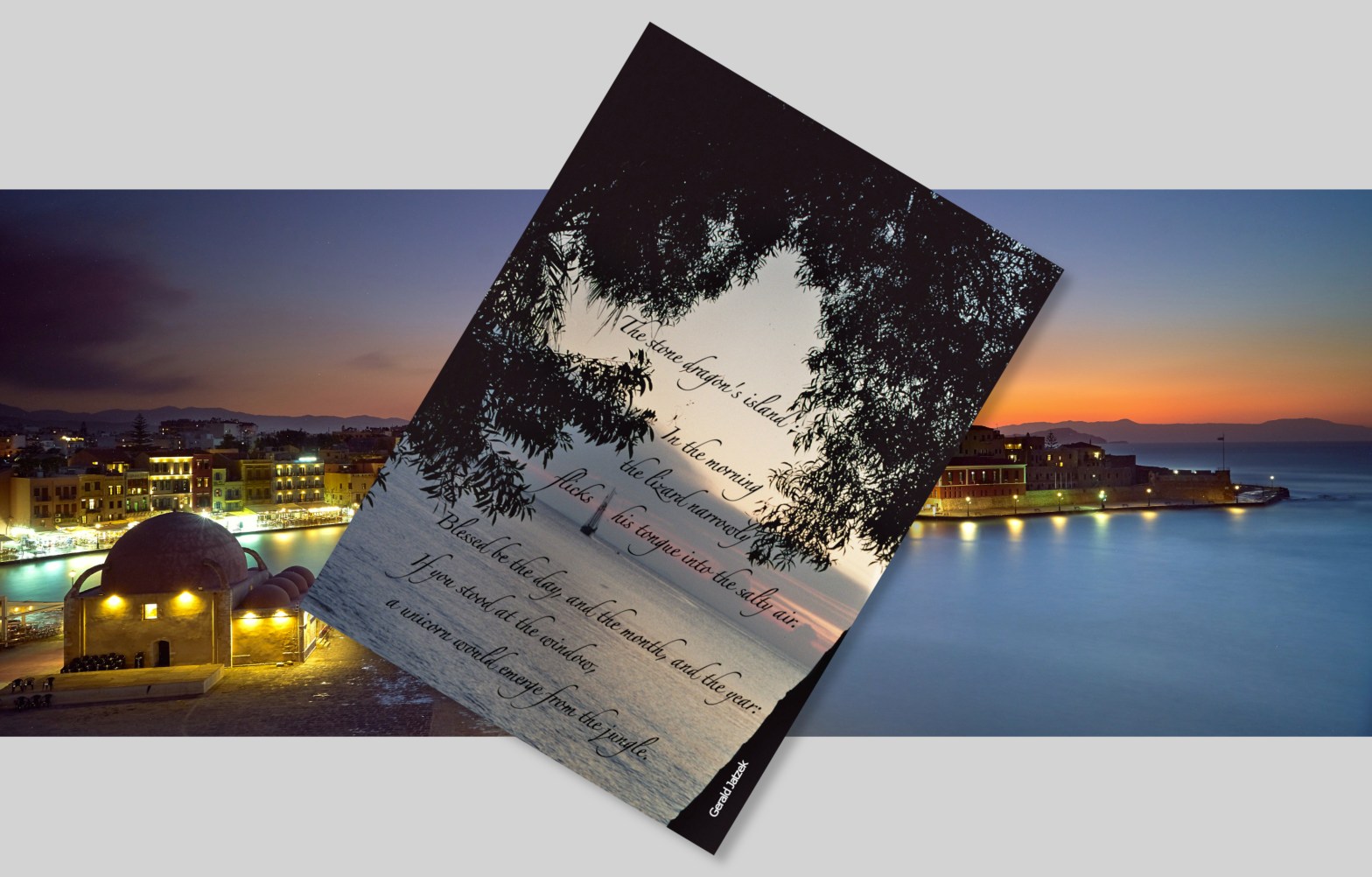
The picture at the top of the article shows a panorama of Chaniá’s port and Gerald Jatzek’s contribution consisting of a dreamlike poem combined with a photo that he took on Tioman. This island off the coast of Malaysia is said to be a fossilized dragon lost in eternal dreams.

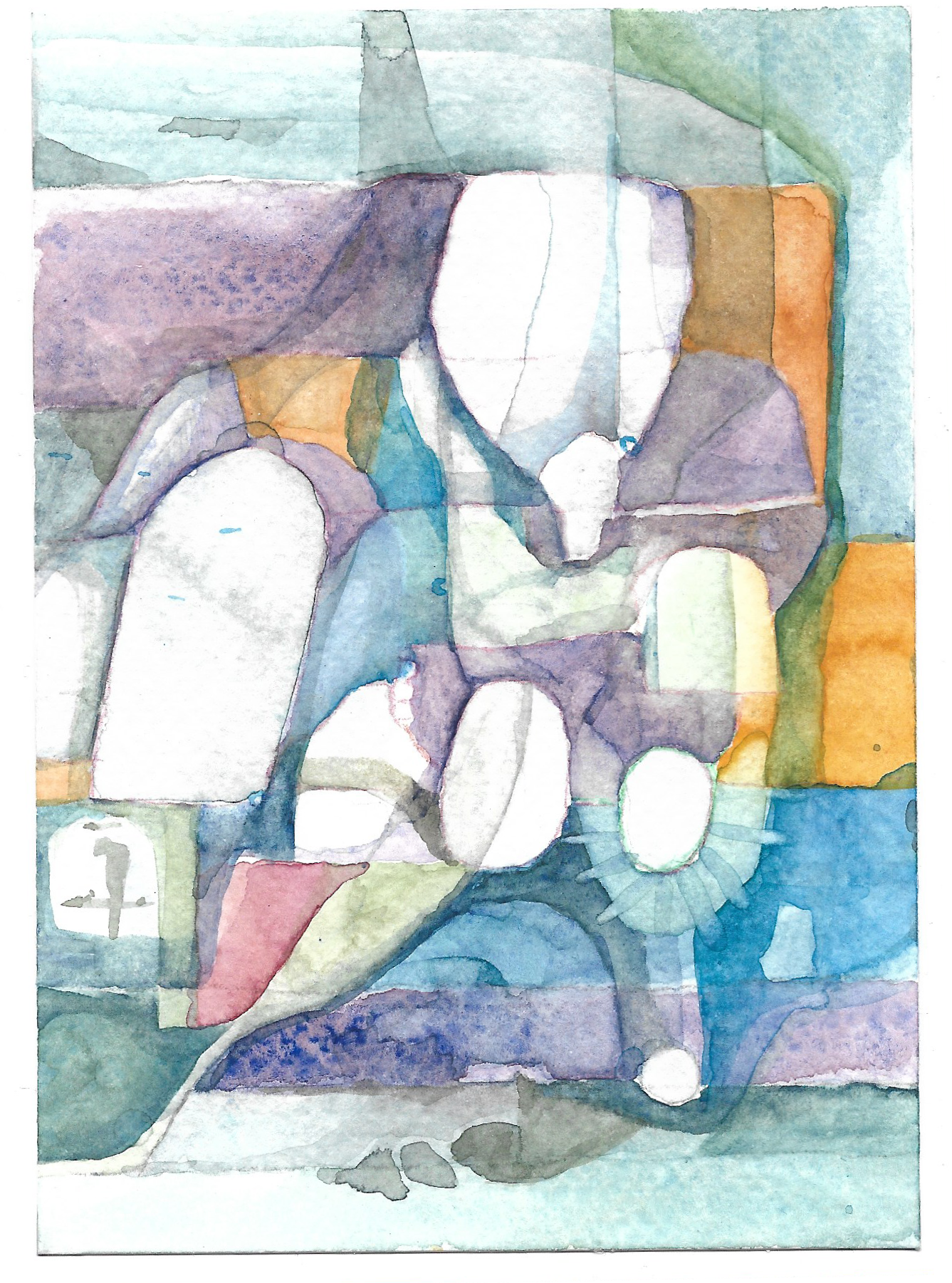
On the right you see Gabriele Müller’s contribution, a watercolor painting of dreams in an imgaginary landscape.

Exhibition

Dream Archive, 4.-17.9.
Ametron Art Space, Theotokopoulou 22, 73131, Chaniá, Crete, Greece

Links

Copyright

Photo of Chanià: Pedro Szekely – CC 2.0

A Reply and a Call

A few days ago, we showed you some items that reached MailYourArt from Berlin. Today it’s time to show the reply mail to Ulli Kattenstroth, a longtime mail art activist whose work can be found all over the place and beyond.

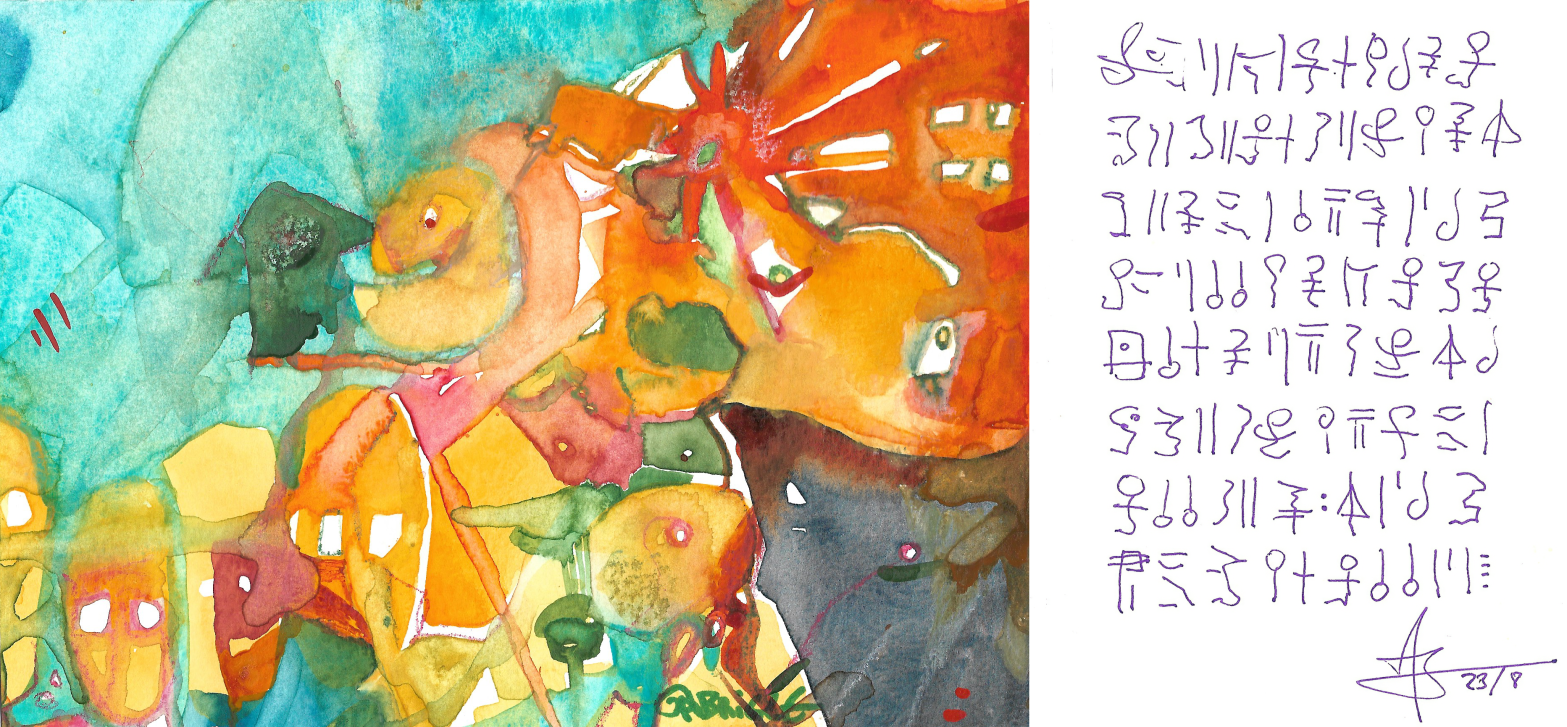
The reply mail included a watercolor sketch by Gabriele Müller and an asemic text by Gerald Jatzek. Or does it make sense nonetheless?

eMail Art Call

Ulli’s current project is a call for art on the topic climate change – a game changer?

He is looking for visual works in postcard size (105 x 148 mm), photos, drawings, paintings, digital works, a.s.o., or texts with not more than 100 words (poems, prose, essays,  visions, tales, a s.o.). All languages are welcome. Look for more information on Ullis website.

Online Exhibition

58 artists, authors, bloggers, photographers and poets from all over the world took part in Ulli’s virtual project. Among them are Horst Tress, Bernhard Zilling and Birgitte Volz Germany, Claudio Gavina and Ruggero Maggi (Italy), Haydar Tascilar and Eren Görgülü (Turkey), Irina Tall (Belarus), Josif Mihailo (Romania) and Gilles Labruyere (France).

The postcard migrant birds, a collective work by Gabriele Müller and Gerald Jatzek, was also included in the collection.

Link

Updated: 12.12.2023