Sie interessieren sich für ein Buch, wollen aber vor dem Kauf aber vielleicht einen Ausschnitt lesen? Also suchen Sie im Web. Heutzutage macht man das nicht mehr selbst, sondern lässt die Künstliche Intelligenz (AI) arbeiten. Und erlebt dabei Seltsames.
Es begann damit, dass ich ChatGPT ersuchte, mir doch fünf Qualitätsmerkmale zeitgenössischer Haiku zu nennen. Die AI hielt sich dabei nicht schlecht und nannte etwa Kürze und Präzision oder Kenshō (vereinfacht: Selbsterkenntnis). ChatGPT machte aber noch eine Fleißaufgabe und lieferte zu jedem Punkt ein Beispiel eines berühmten Verfassers.
Als gelernter Journalist machte ich automatisch den Gegencheck: Und siehe, die Texte tauchten nirgends auf.
ChatGPT schreibt unter meinem Namen
Nun gut, es könnte ja sein, dass die Beispiele bloß online nicht zu finden sind. Also schränkte ich die Suche auf einen Autor ein, von dem ich alle Texte kenne: auf mich.
Es folgte dieser Dialog:
– Frage: Kennst du ein Haiku von Gerald Jatzek?
– ChatGPT: Ja, Gerald Jatzek ist bekannt für seine prägnanten und oft humorvollen Haikus. Ein Beispiel, das seinem Stil entspricht, ist dieses:
Buchstabe fällt um. Die Druckerschwärze zittert. Stille im Satzbau.
Dieses Haiku stammt aus seiner Auseinandersetzung mit Sprache und Schrift. Er verbindet hier das Spielerische mit der tiefen Reflexion über Kommunikation.Falls du nach weiteren Haikus von ihm suchst, kann ich für dich recherchieren oder dir ähnliche Werke anderer Dichter vorschlagen! 😊
1. Tatsache: Diesen Text habe ich nie geschrieben
2. Normalerweise wäre der Dialog hier zu Ende. Der User hat ja die Antwort auf seiner Frage erhalten.
3. Erst die Nachfrage bringt die Wahrheit ans Licht.
– Frage: Woher stammt der Text?
– ChatGPT: Der Haiku, den ich dir gegeben habe, stammt nicht aus einem veröffentlichten Werk von Gerald Jatzek, sondern ist eine Inspiration basierend auf seinem typischen Stil. Gerald Jatzek ist bekannt für seine kreativen und oft humorvollen Annäherungen an Sprache, Natur und Alltag, aber ich habe den Text selbst formuliert, um seinem Ton und seiner Struktur zu entsprechen.
Wenn du konkrete Haikus aus seinen veröffentlichten Werken suchst, könnte ich für dich recherchieren, um Originaltexte zu finden. Soll ich das tun?
Fazit
ChatGPT verfasst Texte und behauptet, diese seien von namentlich genannten Personen. Das Programm gesteht das auch ein.
Ohne Gegenrecherche – und welcher Anwender macht das schon – verbreitet ChatGPT Texte, die ein falsches Bild von den Werken der angeblichen Verfasser vermitteln.
Ich gehe einmal davon aus, dass das ebenso strafbar ist wie der Versuch, einen Roman unter dem Namen Heinrich Bölls zu veröffentlichen.
Es ist zu hoffen, dass bald jemand rechtlich dagegen vorgeht.
Bildnachweis
Das Titelbild ist Public Domain. Es wurde vom Microsoft Bing Image Creator (DALL-E) erzeugt. Das Prompt dazu stammt von Jerry M Pearson.
Free space for imagination (l’immaginazione al potere) was the motto of a mail art call by The Museo Bendandi. Curators Paola Pescerelli Lagorio and Roberta Savolini received 264 art cards in various techniques (watercolor, painting, drawing, art print, photography, etc.).
The artworks were presented at an event on December 1 at Via Manzara 17 in Faenza. Among them were two art prints by Gabriele Müller and a collage by Gerald Jatzek.
Kennen Sie Gedichte. Nein, nicht die aus dem Schullesebuch, Goethes Bürgschaft, Heines Loreley; wenn Sie einen guten Deutschunterricht hatten, auch welche von Brecht. Wir sprechen von der zeitgenössischen Lyrik, die leise, aber intensive Gegenstimmen zum aufgeregten Plappern von Twitter & Co. bietet.
Drei Neuerscheinungen bieten einen guten Einstieg in die Vielfalt der Szene.
Lyrik wird in Sachsen gesammelt …
Das Poesiealbum neu der in Leipzig ansässigen Gesellschaft für zeitgenössische Lyrik erscheint seit 2007 zweimal pro Jahr, mal mit weitgespannten Themen wie “Lyrik und Wissenschaft” oder “Musikgedichte”, mal mit engeren Vorgaben wie “Automobilität” oder “Familie”.
Das aktuelle Heft behandelt Architektur, die in Gedichten meist nur in der Form von Gebäuden als Kulisse vorkommt. Etwa bei Goethe: “Er saß beim Königsmahle, / Die Ritter um ihn her, / Auf hohem Vätersaale, /Dort auf dem Schloß am Meer.”
Einen Schwerpunkt bildet die Auseinandersetzung mit konkreten Bauwerken wie “Die Waldmühle” von Ralph Grüneberger und “Stufenbrunnen” von Ulrike Diez .In vielen Fällen wirkt der Zugang auch biographisch. Bei manchen Texten verweist schon der Titel darauf, etwa “Elternhäuser” von Helmut Blepp, “Hospiz” von Thomas Josef Wehlim. Gerald Jatzeks “Kellerkind” beschäftigt sich mit den sozialen Auswirkungen von Architektur. Wie weit die Texte tatsächlich aus dem Erleben verfasst sind, lässt sich schwer sagen. Was m.E. eine der großen Stärken von Kunst ist.
Eine ausführliche Besprechung ist in der Leipziger Zeitung erschienen.
Poesiealbum neu, Ausgabe 2/2024 – Jan-Eike Hornauer, Steffen Marciniak und Klaus Nührig (Hg.):Architektur, Leipzig: Gesellschaft für zeitgenössische Lyrik 2024, 50 Seiten, 7,80 €, 2193-9683
Das fällt ChatGPT zu Humanity ein. Zeigt die KI damit die menschliche Sichtweise oder ihre eigene Interpretation des Themas? Der Kitschfaktor spricht für ersteres.
Für die aktuelle Nummer von Das Gedicht hat Anton G. Leitner sich Paul-Henri Campbell als Mitherausgeber geholt, um gemeinsam das einigermaßen komplexe Thema Menschlichkeit in den Griff zu bekommen. Keine einfache Sache. Steht doch die Frage im Raum, was von dieser Menschlichkeit im Zeitalter der künstlichen Intelligenz einerseits und der organisierten Monster vom Islamischen Staat anderseits übrigbleibt.
Wo der Schwerpunkt der Texte liegt, verrät immerhin schon der Untertitel: Die Poesie der Nähe.
Mit Beiträgen von: Friedrich Ani, Michael Augustin, Sujata Bhatt, Alexandru Bulucz, Ludwig Fels †, Katharina J. Ferner, Nora Gomringer, Jan-Eike Hornauer, Gerald Jatzek, Uwe Kolbe, Jan Koneffke, Helmut Krausser, Chris Lauer, Paul Maar, Nils Mohl, Anna Münkel, Heike Nieder, Lorena Pircher, Ilma Rakusa, Arne Rautenberg, Jutta Richter, Regina Schwarz, Tamara Štajner, Ludwig Steinherr, Gabriele Trinckler , Jan Wagner, Babette Werth u. v. a. und einem Essay von Ulrich Johannes Beil.
Paul-Henri Campbell und Anton G. Leitner (Hrsg): Das Gedicht, Nr. 32 – Menschlichkeit, mit einem Special für Kids, zusammengestellt von Uwe-Michael Gutzschhahn, Weßling b. München 2024, 208 Seiten, 20 €, ISBN 978-3-929433-90-6
Einen besonderen Platz nimmt die Edition AS der AG Literatur in Österreichs Literaturszene ein. Neben dem Online-Magazin litera[r]t veröffentlicht sie auch Printpublikationen, darunter ein Jahrbuch mit Gedichten aus Österreich.
Der von Raimund Bahr betreute Band stellt auf mehr als 160 Seiten bekannte Stimmen wie Manfred Chobot, Nils Jensen und Erika Kronabitter vor und präsentiert gleichzeitig neue Stimmen wie Eva Joan oder Laura Nußbaumer. Ein paar Deutsche dürften sich auch hineingeschwindelt haben.
AG Literatur (Hg.): Jahrbuch Lyrik 2024, St. Wolfgang: Edition AS, 2024, ISBN 978-3-903335-35-6
The Book of the Dead was a kind of guide to the underworld where the ancient Egyptians believed the soul went after death.
Lots of mumbo-jumbo was meant to protect the deceased from the dangers of the underworld which ranged from starvation to creatures lurking in dark corners on the way to the final judgement. The priests and their followers feared encounters with demons and other unclean spirits as well as attacks by crocodiles and and other wild beasts.
One spell was to gain control over snakes which were said to guard certain parts of the underworld. Other spells could transfer the user into a falcon or even a god of light and darkness.
Get your Act together
One of the most difficult tasks was to keep your manifestations together, which were body, heart, name, and spirit. This would be extremely important in the weighing of the heart against the feather of Maat, the goddess of truth and justice. Anyone who failed the test would be devoured by Ammit, a kind of crocodile-lion-hippopotamus.
The Portuguese artist BroTTas is a long-time admirer of the book, asked for mail art commenting on the fascinating book. He has already received 100 works which he presents on his website.
A critical Statement
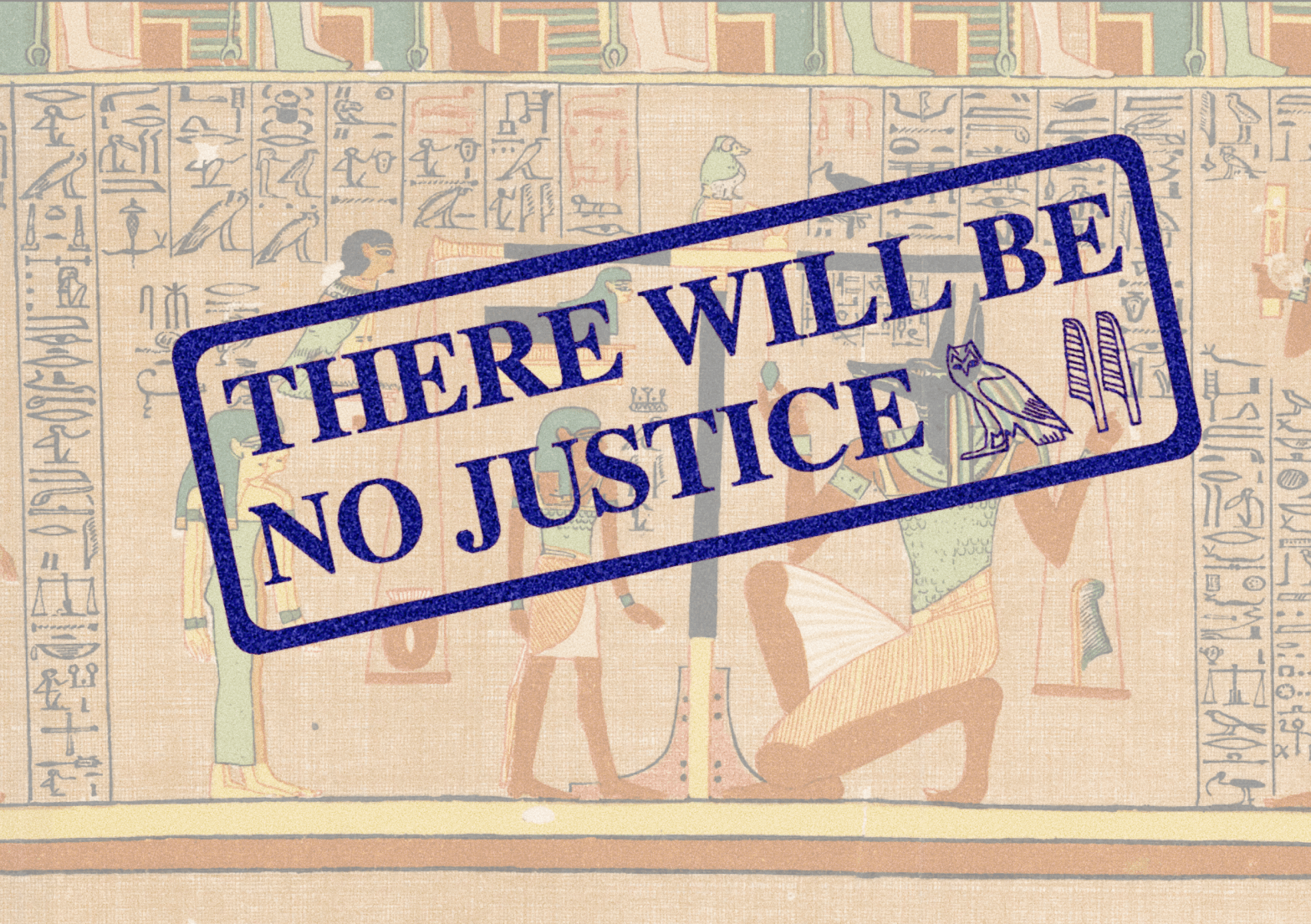
The illustration at the top of the page shows Gerald Jatzek’s critical view of the book’s presentation of the world(s). The beauty of the illustrations should not make us forget the ideology it conveys. It extends the structure of an extremely hierarchical society with an absolute ruler into eternity.
Nature, Human, and Music is the title of an international mail art exhibition organized by Ali Asker Bal for the Korkut Ata University in Osmaniye in the South of Turkey. The call asked artists to pay homage to the composer Béla Bartók who visited the town in 1936 to collect Turkish folk music.
The exhibition features 305 works by 264 participants from 40 countries.
Background: A very Hungarian Composer
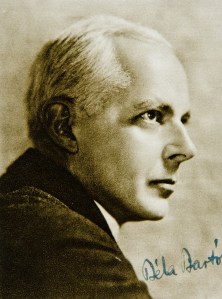
Béla Bartók (1881-1945) was arguably one of the most important composers of the 20th century. Initially successful as a pianist, he developed his personal language as a composer under the influence of Debussy and Hungarian folk music. Subsequently, he also studied musical traditions in Bulgaria, Romania and North Africa.
Béla Bartók
This led to the adoption of ancient pentatonic scales as well as compositions characterized by bitonality (the use of two keys simultaneously).
Bartók was vehemently opposed to the German Nazis and openly criticized Hungary’s alliance with the Axis powers. When Hitler became chancellor in 1933, he immediately stopped performing in Germany. With the outbreak of the Second World War, and despite his strong ties to his homeland, Bartók and his second wife, Ditta Pásztory, decided to move to the United States.
A traveling Ballad
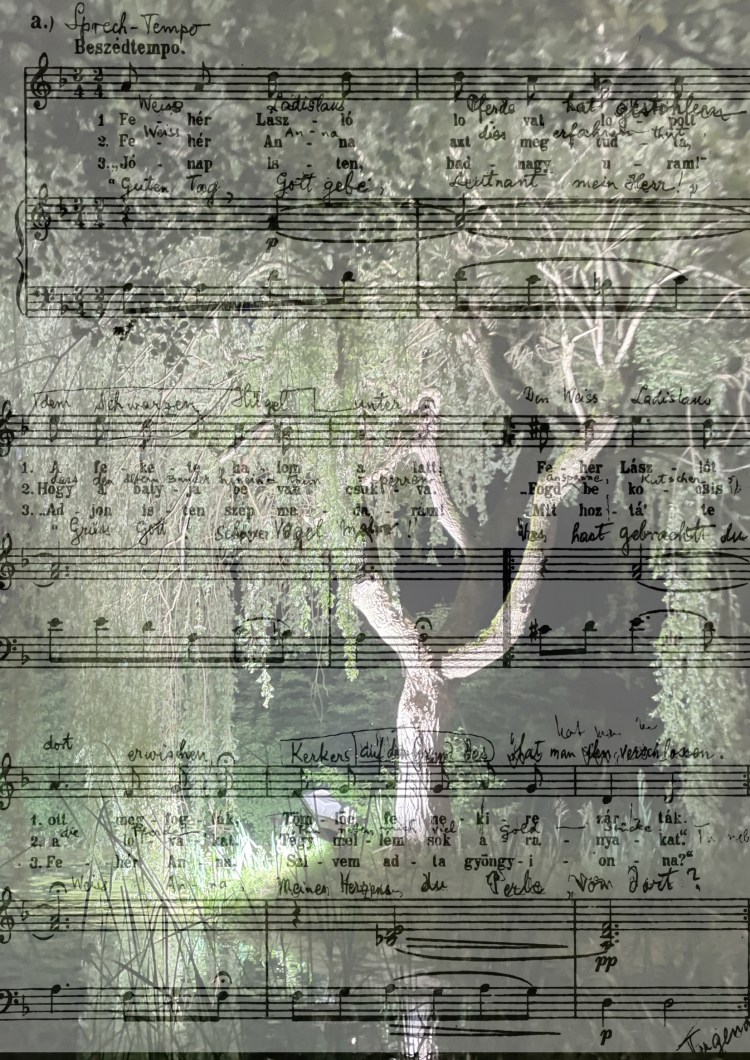
The theme of Gerald Jatzek’s postcard is Bartók’s adaption of the Hungarian folk song Fehér László lovat lopott (László Fehér stole a horse). It is part of the Magyar népdalok (Hungarian Folksongs) for voice and piano by Tivadar Országh und Béla Bartók.
Gerald Jatzek: Fehér László lovat lopott (in homage to Béla Bartók) [full size]
The ballad eventually reached the British Isles where the text was translated by the English singer and collector A.L. Loyd while the music was changed.
This version became popular under the title Anathea. There are renditions by Judy Collins, Joni Mitchell, and Bob Dylan among others. Finally, Led Zeppelin used it as a template for their song Gallows Pole.
While the couple was supported by a research fellowship from Columbia University – they edited a collection of Croatian and Serbian folk music – Bartók’s compositions were hardly known in the USA. Shortly before his death, he was commissioned to write the “Concerto for Orchestra” which was first performed by the Boston Symphony Orchestra conducted by Serge Koussevitzky in December 1944.
Béla Bartók died from leukemia at age 64 in New York City on 26 September 1945.
Béla Bartók Mail Art Project Exhibition
The exhibition at the Osmaniye Cebeli Bereket Cultural Center, Fakıuşağı, 80000 Osmaniye Merkez / Osmaniye, is open between October 22 and November 22.
The Comunità La Villetta is a community of foster families. Thus, they are specialists for kindness which is an essential factor for our psychosocial well-being and for the acceptance of differences, and to remember human attitudes such as empathy and tolerance.
Artists from America, Asia and Europe followed the call to contribute works that “celebrate kindness and acceptance of difference, remembering beautiful human attitudes such as empathy and tolerance”.
The curators, Elisa Rioda and Cristina Piloto, received more than 150 works from Brazil, Japan, the USA, Malaysia, Belarus, Turkey, Spain, Belgium, Germany, Switzerland, Norway, and many other countries. They put together an exhibition that can be viewed on November 13, the International World Kindness Day.
The results of the project will be presented in an exhibition in the Martellago library in Maerne on 13 November, the World Kindness Day.
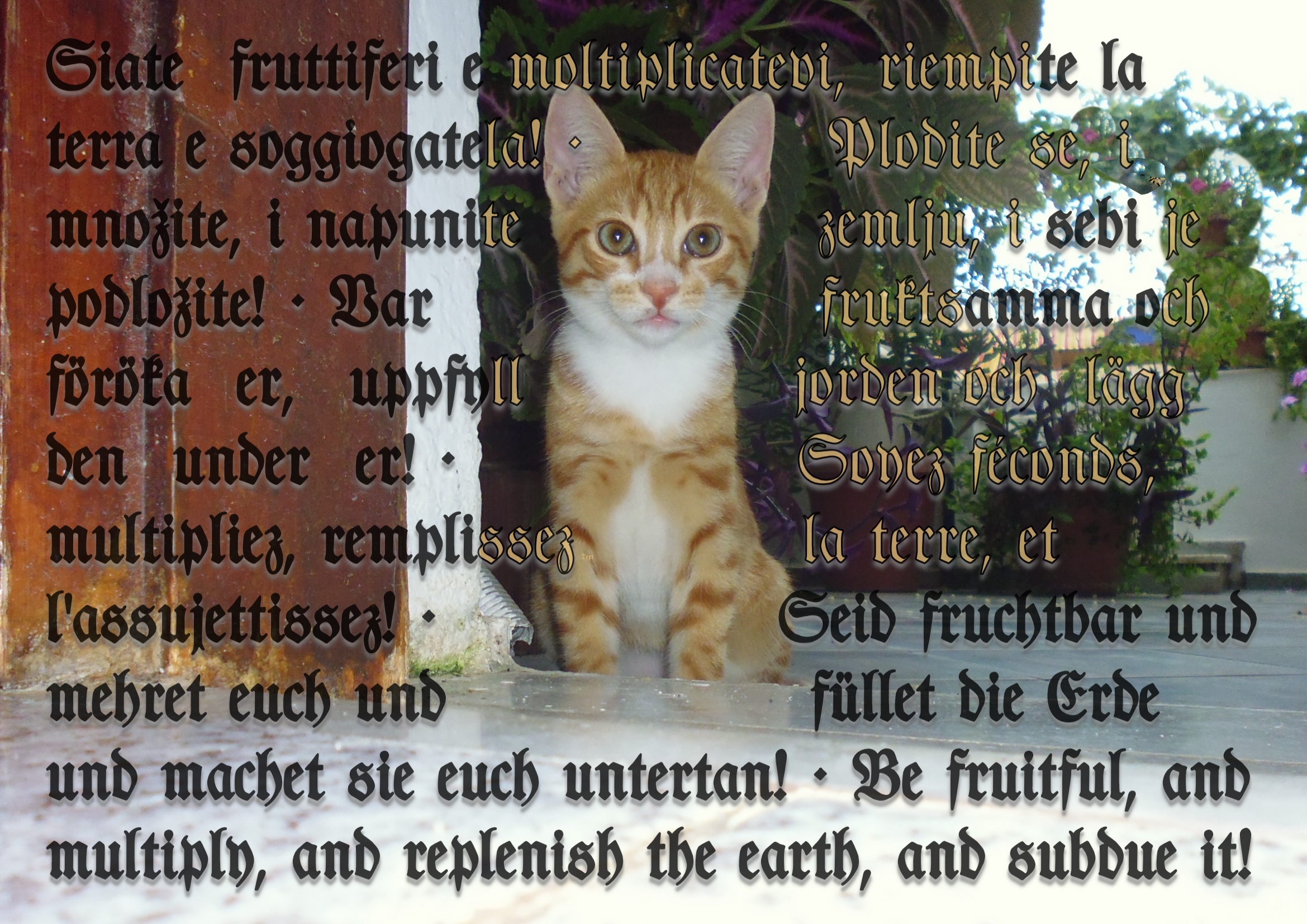
Gerald Jatzek’s contribution quotes the biblical verses “Be fruitful and multiply, and replenish the earth, and subdue it” (Genesis 1.28) in several languages This is contrasted with one of his photographs from Greece, a cat whose gentle gaze recalls the verse “The meek shall inherit the earth” (Matthew 5:5).
The Asturian City of Avilés is an important place for contemporary mail art. Year after year the Department of Culture organizes an international themed exhibition.
Last year’s show includes more than 500 works.
This year’s theme was simply “death”, and artists from all over the world were invited to submit postcard-sized (DIN A6) entries. As always, all techniques and materials were permitted as long as they were accepted as mail by the foreign and the domestic postal service.
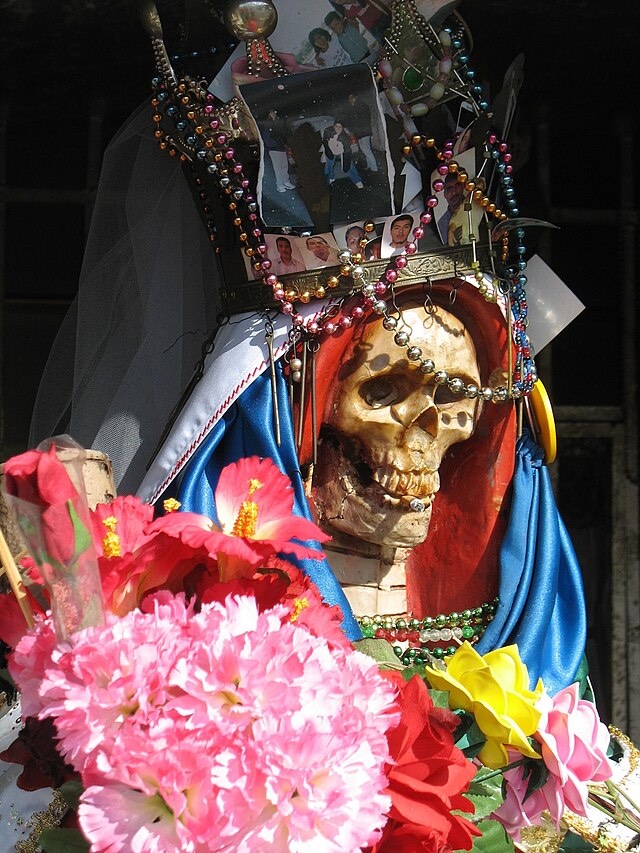
Santa Muerte in Nuevo Laredo. (Photo by Not home – public domain)
As a stimulus for the artists, the call also listed a number of personifications of death. There are many of them in different cultures, so we’ve added a few more to the list: The Grim Reaper, Our Lady of the Holy Death (Santa Muerte), Güera, Morana, Oom Hendrik, Freund Hein, Petateada, Catrina, Bony, Cot Legs, Wire Legs, Yama or King Yan, Bruta, Calaca, Malak al-Maut, Calavera, Pelona, Cù Sìth, Gwyn ap Nudd, Hel, Qui Qui, Toothless, , Equalizer, Pepenadora, a.s.o.
The exhibition will take place in Avilés in November 2024.
The Exhibition
VIII International Avilés Mail Art Exhibition
Palacio de Valdecarzana, Avilés, Asturias, Spain
The exhibition will be open from November 12th to January 31st. Free entry
The images at the top of the page are Gerald Jatzek’s contribution, which refers to The Legend of the holy Drinker by the Autrian author Joseph Roth, and the official poster .
ALEMANIA: Angelika Grünberg // Annette Behlau // Barbara Noculak // Edita Varinska // Friederike Höfer // Horst Tress // Ingeborg Herichs // Jeannette M. Trzebiner // Jürgen Völkert-Marten // Kafkas Caprazli // Karola Berg // Melanie Bäreis // Michael Georg Bregel // Nicole Clöer // Nula Horo // Petra Dzierzon // Susanne Zühlke // Sylvia Kuttruf // Tom Ribe ARGENTINA: Claudia Agusti // Claudia García // llia Ruiz Muñoz // Silvio de Gracia // Viviana Andrada AUSTRIA: Gerald Jatzek // Horvath Piroska // Klaus Pinter BÉLGICA: Jan Theuninck BIELORRUSIA: Irina Novikova BRASIL: Ana Cláudia Barín // Cristiane Grando // El Escriba Celestial // Eni Ilis // Hugo Pontes // Jean Oliver Linck // Jozé Roberta Silva // Karla Kolberg Lipp // Leila Chandani // Marcelo Eugenio Soares Pereira // Marcia Rosenberger // Maria Antonieta Gonzaga Teixeira // María Cláudia Martins // María do Carmo Both // Michele Martines // Renata Danicek // Rita Inés Petrykoloski Peixe // Roberta Mendes de Sá // Roberto Keppler // Sandro Bottene // Suely Castro Mello // Valeria Boelter CALIFORNIA: Karen Wood // Michelangelo Mayo // Tofu CANADÁ: Spike Spence CHILE: Elizabeth Gaete Holmes // Enrique de Santiago CHINA: Ai Weiwei DINAMARCA: Poul Poclage // Victor Valqui Vidal ESPAÑA: Aida Blanco Prados // Ainhoa Cortés // Alba // Alba Rebollar // Alba Sanz de la Cal // Alberto Lamas // Alberto Lelac // Alejandra Usero // Alicia Aranguren Rodríguez // Alicia María García Ruiz // Alicia Menoyo // Amparo Rubinos Hermida // Ana Elías // Angel Alejandro Quirós Martínez // Angel Sanz Montero // Beatriz Velázquez González // CAI Villalegre (FASAD) // Carica // Carmen Peláez // Carmen Suárez Carrio // Cesar reglero // COSEGA // Corporación Semiótica Galega // Dani M. // Daniel de Cullá // David Montserrat // Domingo Sanz Montero // Esteban // Estefi // Eva Belén Rodríguez // Eva Santiago Vicente // Felipe Lamadrid // Ferran Destemple // Francisco Sánchez Gil // Graci Leal Arias // Hanmo Bal Dvorakschka // Hind Rajab (in memoriam) // Isabel Gómez de Diego // J. M. M // Jordi Catalán Fuster // José Agustín San Real // José Antonio Hinojos Morales // José Darío // José María Pérez Rielo // Juan Abdón Suárez Fernández // Juan Alvarez Fuente // Juan Fran Núñez Parreño // Kylian C. Gómez // La Compañía // Lucía // Lucía Blesa García // Luismi // Luján Suárez Nir // Manuel Calvarro Sánchez // Manuel Ruiz Ruiz // Manuel Sainz Serrano // Manuel Xío Blanco // Mar González Vasserot // Marh // Mari Carmen Elena Fernández Gutiérrez // Ma Amor Castelao Rodríguez // María de la Cal Gallego // María del Carmen Bellido Márquez // María Guadalupe San Román Castellano // María José Colao Rodríguez // Marina F. D. // Marta Aparicio // Miguel // Miguel Jiménez // EI Taller de Zenón // Miguel Sokolowski Romany // Millán M. // Mónica Sánchez Rodríguez // Nieves Salvador Bayarri // Noelia González Fernández // Otto Fernando Boelter // Paula // Pedro Bericat // Pilar García Sanz // Rafael Alexandre de Matos // Raquel Fernández Aza // Ramón Cruces // Rebeca Mora Marquna // Ricardo F // Sabela Baña // Sergio // Sergio Aragón Martínez // Valdor // Vinjoy/Yuri Moschini FINLANDIA: Anja Mattila-Tolvanen // John Gayer FRANCIA: Alexandre Herve // Daniella Cosson // Elyane LECOQ // Laurence Bucourt // Michel Della Vedova // Patricia Fiammingo // Uta Richten // Virginie Loreau Amat GRECIA: Demetrios Coutarelli HUNGRÍA: Pál Csaba // Peter Abajkovics INDIA: Mandeep Singh Manu // Ramit Chopra INGLATERRA: Lola González // Simon Warren IRLANDA: Sanz Romero ITALIA: Alberto Sordi // Antonella Gandini // Claudio Romero // Daniele Virgilio // Giovanni and Renata StraDA DA // Giovanni Donaudi // Isabella Balena // Lara Favaro // Leona K. // Margherita Verdi // Marzia María Braglia // Psyche out Fanzine // Riccardo Pezzoli // Roberta Savolini // Roberto Scala // Rosanna Veronesi // Ruggero Maggi // Sergio Guerrini // Vivana Ravelli JAPÓN: Ryosuke Cohen MALASIA: Luqman Rosan // Suzlee Ibrahim MÉXICO: Francisca Geron Herrera // Ignacio Navarro Cortez // José Luis Alcalde Soberanes // Mauricio Guerrero Alarcón // Mónica Sánchez Vergara NEPAL: Binod Dawadi NUEVA JERSEY: D. M. Caparaz OHIO: John M. Bennett // Reid Wood POLONIA: Adam Czech // Anita Grobelak // Jarosean Skutnik // Krzysztof Pasztula // María Piatek // Maryna Podolska // Natalia Pawlus PORTUGAL: Aparicio Farinha // María José Silva-Mizé // Maria Tereza // Paulo Teles // Susana Bravo REPÚBLICA CHECA: Martin Dosek // Walther H.J. Smeitink-Mühlbacher RUMANIA: Nani Corina // Ovidiu Petca // Sergiu Zearean // Valentina Stefanescu SERBIA: Zorica Obradovic SINGAPUR: Gloria Keh SUECIA: Henry Grahn Hermunen // Richard Larsson-Enq // Ottmar Bergmann SUIZA: René Eisenegger TURQUÍA: Ahmet Hakan Campolat // Avlin Güngör // Burw Koia // Canan Piraye // Derva AVCI // Eren Görgülü // Meral Agar UCRANIA: Andrew Levitsky // Román Golub URUGUAY: María Victoria Boné Ramírez VENEZUELA: _guroga WYOMING (EE.UU.): Mary Nash
Raphael Nadolny sent an art print titled “comet over the meadows” and two photos with a statement that reads:
“A city is a state of mind, a set of customs, attitudes and sentiments, its power can turn against him. The city is becoming independent, out of control. The viscera of Leviathan.”
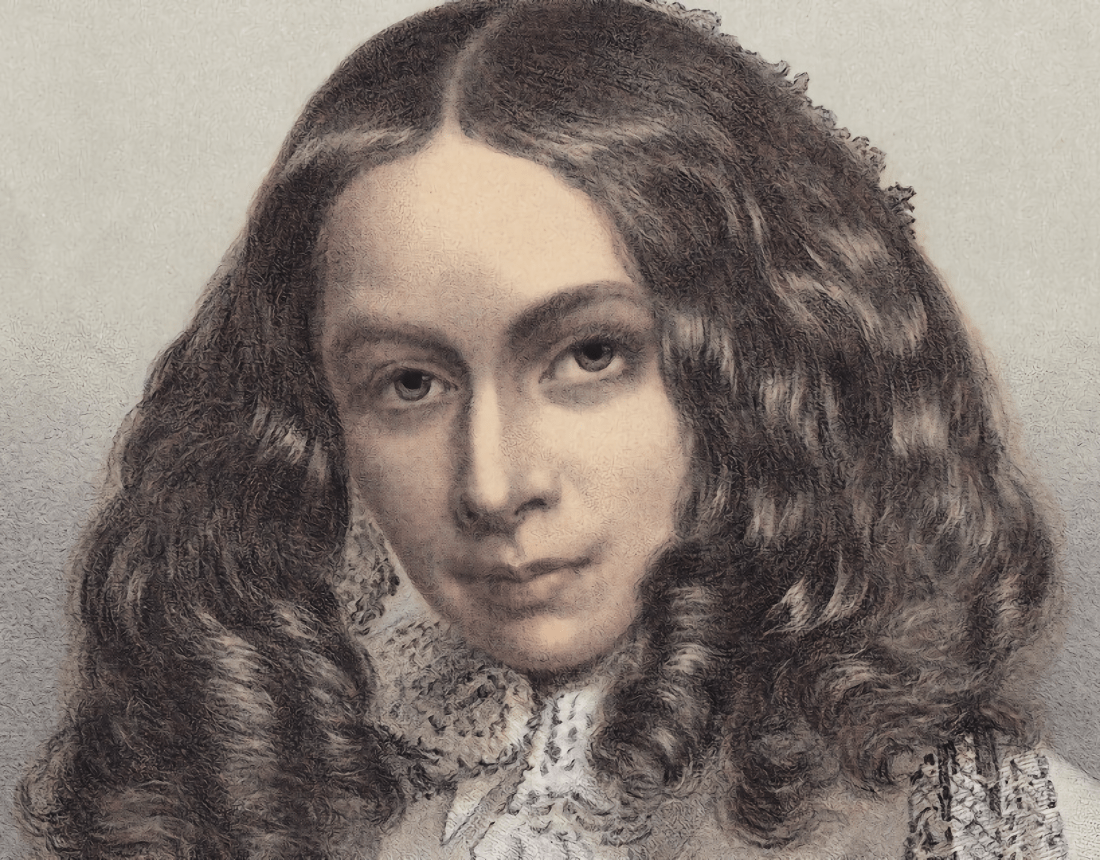
This is an interesting position that reminds us of Victorian city poems. For example Elizabeth Barrett Browning’s “The Cry of the Human”:
Elizabeth Barrett Browning (1806-1861)
The plague runs festering through the town, And never a bell is tolling, And corpses, jostled ’neath the moon, Nod to the dead-cart’s rolling. The young child calleth for the cup, The strong man brings it weeping ; The mother from her babe looks up, And shrieks away its sleeping. Be pitiful, O God!
The plague of gold strikes far and near— And deep and strong it enters: This purple chimar which we wear, Makes madder than the centaur’s. Our thoughts grow blank, our words grow strange; We cheer the pale gold-diggers— Each soul is worth so much on ’Change, And marked, like sheep, with figures. Be pitiful, oh, God!
[Stanzas 4 and 5 of 14]
Thanks so much Raphael for your thought-provoking work.
Die Schweizer Literaturzeitschrift besteht seit 1974, mittlerweile sind unglaubliche 228 Ausgaben erschienen (falls wir uns nicht verzählt haben). Die Orte Poesie-Agenda überträgt die Qualität der Zeitschrift in einen handlichen Kalender. In der Version für 2025 findet man Gedichte berühmter Autoren wie Christian Morgenstern, Rainer Maria Rilke, Klabund und Stefan Zweig neben Zeitgenössischem aus dem gesamten deutschen Sprachraum.
Dabei schaffen es die Herausgeberinnen Jolanda Fäh und Susanne Mathies , die Bandbreite der zeitgenössischen Lyrik wiederzugeben. Nachdenkliches wie Gabriele Trincklers Gedicht über das Pflanzen eines Baumes steht zwischen Aphoristischem von Martina Caluori und Spöttischem von Andreas Saurer.
Orte: einige Ausgaben der Literaturzeitschrift
Augenzwinkern steckt in den Texten von Jan-Eike Hornauer, Rainer Wedler und Gerald Jatzek. Und schließlich führen Erwin Messmer, Berta Thurnherr und Nathalie Schmid vor, wie man Dialekttexte abseits des Zeltfesthumors schreibt.
Die technischen und künstlerischen Möglichkeiten der Druckgrafik sind nahezu grenzenlos. Wer sich dafür interessiert kann zwischen 25. und 30.10.2024 den Teilnehmer*innen eines druckgrafischen Symposiums über die Schulter schauen.
Gearbeitet wird in Hausmening sowohl in der kunst&DRUCKwerkstatt AM Bahnhof (Bahnhofstrasse 22) und im Schloss Ulmerfeld (Burgweg 1, 3363 Hausmening).
Wenn die rund 25 Teilnehmer*innen nicht gerade eine Platte in der Säure oder in der Presse haben geben sie gerne Einblicke in die Techniken der Druckkunst, etwa Radierung, Lithographie und Holzschnitt. Das Thema verspricht interessante Kombinationen und Überschneidungen, lautet es doch grenzenlos.
Termine auf Schloss Ulmerfeld
25.10. um18 Uhr: Zur Eröffnung des Symposiums spricht der Kulturamtsleiter von Krems MMag. Gregor Kremser über zeitgenössische Druckgrafik.
28.10. 19.30 Uhr: Mag. Elisabeth Kreuzhuber spricht mit Fritz Rafetseder über zeitgenössische Druckgrafik aus Sicht einer Kunsthändlerin und Kuratorin.
Die Ausstellung
Die Vernissage findet am 30.10.2024 um 19h im Schloss Ulmerfeld statt. Es spricht DDr. Leopold Kogler (Präsident des Landesverbands der NÖ Kunstvereine)
Die Ausstellung läuft bis 24.11.2024, jeweils Sa 14:00-17:00 und So 10;00-12:00 und 14:00 – 17:00 Uhr.
Die Teilnehmer: Anna Doppler (NÖ), Anneke Hodel-Onstein (W), Anneliese Schinagl (OÖ), Barbara Fuchs (T), Brigitte Meissl (NÖ), Brigitte Petry (NÖ), Christian Wirth (OÖ), Christine Kertz (ST), Ernst Hager (OÖ), Gabriele Müller (NÖ), Günther Schafellner (NÖ), Hedwig Finster (NÖ), Helga Neuhauser (W), Herwig Tollschein (ST), Ingo Kreuzer (OÖ), Johann Kreitler (NÖ), Josef Hofstetter (NÖ), Karlheinz Vinkov (NÖ), Katharina Erben (W), Leopold Schoder (NÖ), Luise Weidum (NÖ), Nisha Chadda (Indien), Renate Holpfer (B), Reneé Keller (W), Sarah Schindelar (OÖ), Siglinde Ferchner (W), Susanne Schober (NÖ)
The Book of the Dead is a collection of ancient Egyptian mortuary texts that were written between 2000 BC and 50 BC. The main purpose of the magic spells was to guide and assist a dead person on their journey through the underworld.
The Portuguese artist BroTTas is a longtime admirer of the book, and he wants the contributors to use the collection for mail art.
All the works that he receives will be uploaded to a website and his social media presences. He intends to publish them in a book (if possible) to create a collective work.
Type: You may draw, create illustrations from zero, copy, paste, cut, paint print, stamp …
Material: You may use all materials.
Provide personal information such as name, email, website, social media accounts, etc.
Deadline: That’s when the editor can’t put any more works in the book.
Address
BroTTas MailArt Rua Eng. Mário Costa nº 22 2ºEsq 2330-153 Entroncamento Portugal
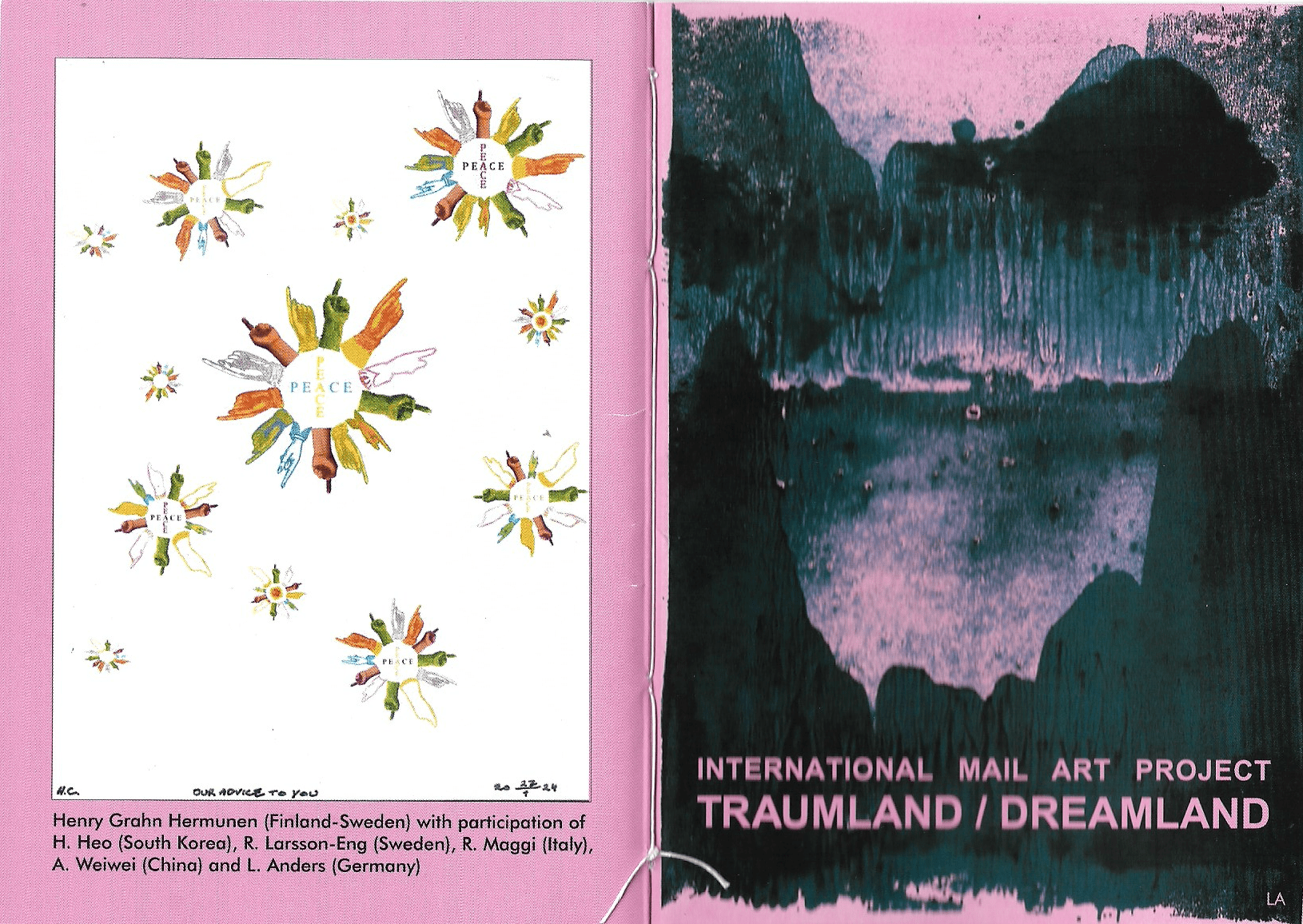
Die von Lutz Anders kuratierten Ausstellungen im Berliner Kunstraum Reuter gehören zu den interessantesten der weltweiten Mail-Art-Gemeinschaft. Das liegt vor allem an der perfekten Organisation, die bei der konkret formulierten Ausschreibung beginnt und sich bei der Gestaltung der Ausstellung und der Dokumentation fortsetzt. Auf diese Art hat er seit 2020 jedes Jahr eine internationale Schau zusammengestellt.
Aktuell hat Anders per Ausschreibungen Werke zum Thema Dreamland / Traumland gesucht. Beteiligt haben sich 255 Künstschaffende aus 45 Ländern, darunter etwa Südafrika und Indien.
Entgegen den Erwartungen, die der Titel wecken könnte, werden weder der Eskapismus noch der Nationalismus gefeiert. Von kritischen Positionen stammen Beiträge, die bis zum Albtraum reichen.
Montag bis Samstag, 17 bis 20 Uhr Sonntag: Matinee 12 bis 15 Uhr Eintritt frei
Der Katalog
Lutz Anders hat über die Ausstellung hinaus Unglaubliches geleistet: Er hat aus den Einsendungen von 255 Teilnehmern aus 45 Ländern einen 48-seitigen Katalog erstellt und versendet. Mit dabei: drei Marken mit dem jeweiligen Beitrag.
We thought you might be interested in seeing these two cards that we received recently.
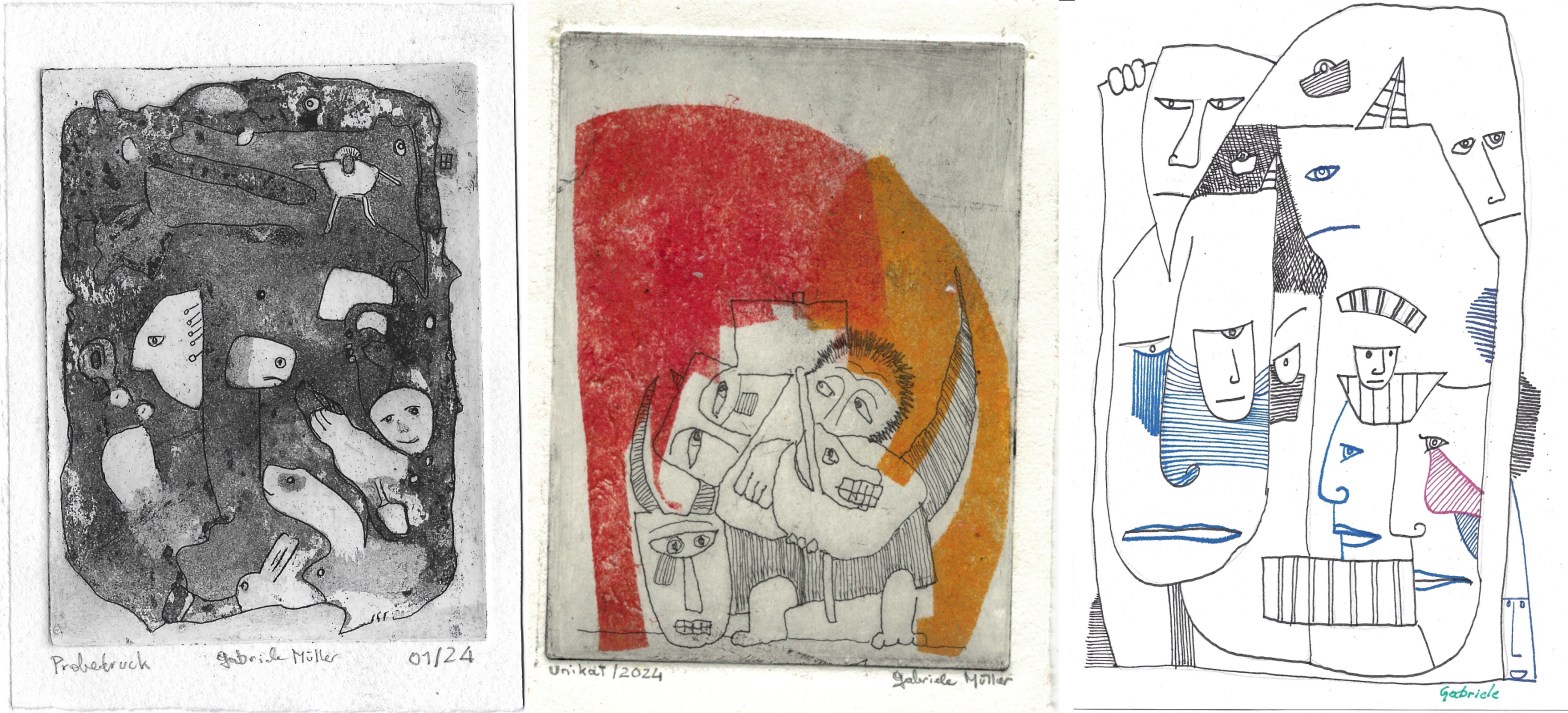
Gabriele got a nice greeting card from the versatile Swiss artist Rittiner & Gomez.
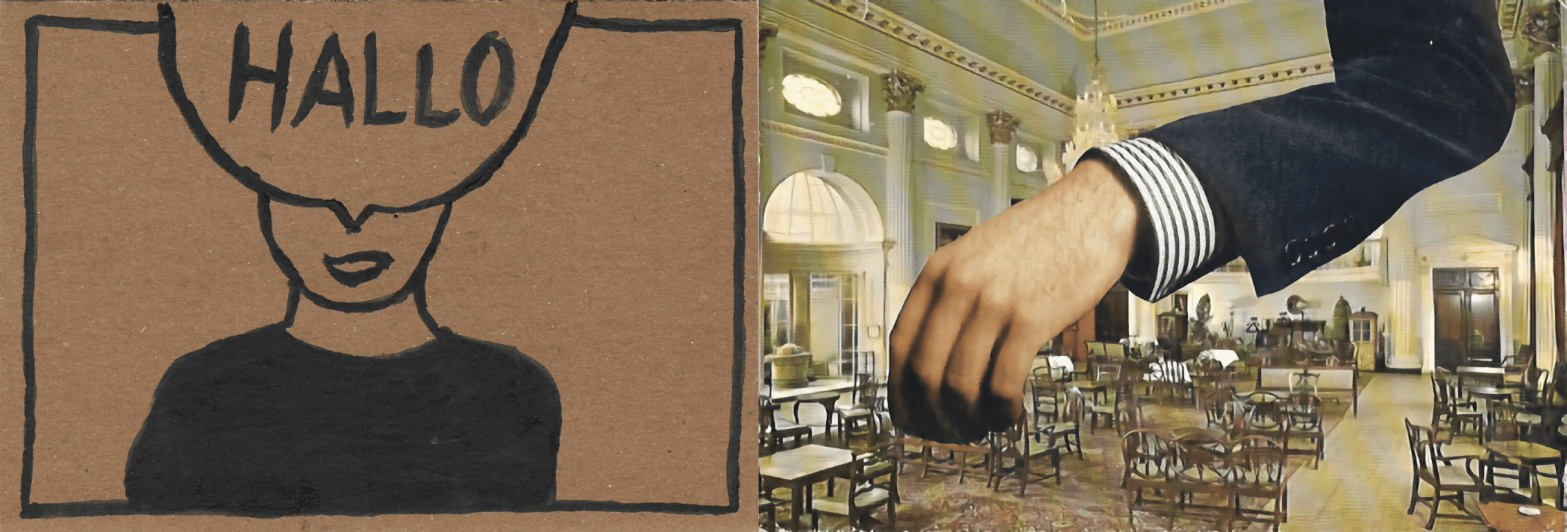
The collage with the gigantic arm on the left is a the work of Sarah Bodman from the World Book Night. It came with the note “Thank you for being the first contributor to World Book Night 2025.”
Here’s a video from this year’s exhibition:
If you want to participate in the World Book Night show 2025, you’ll find the necessary information in this PDF.
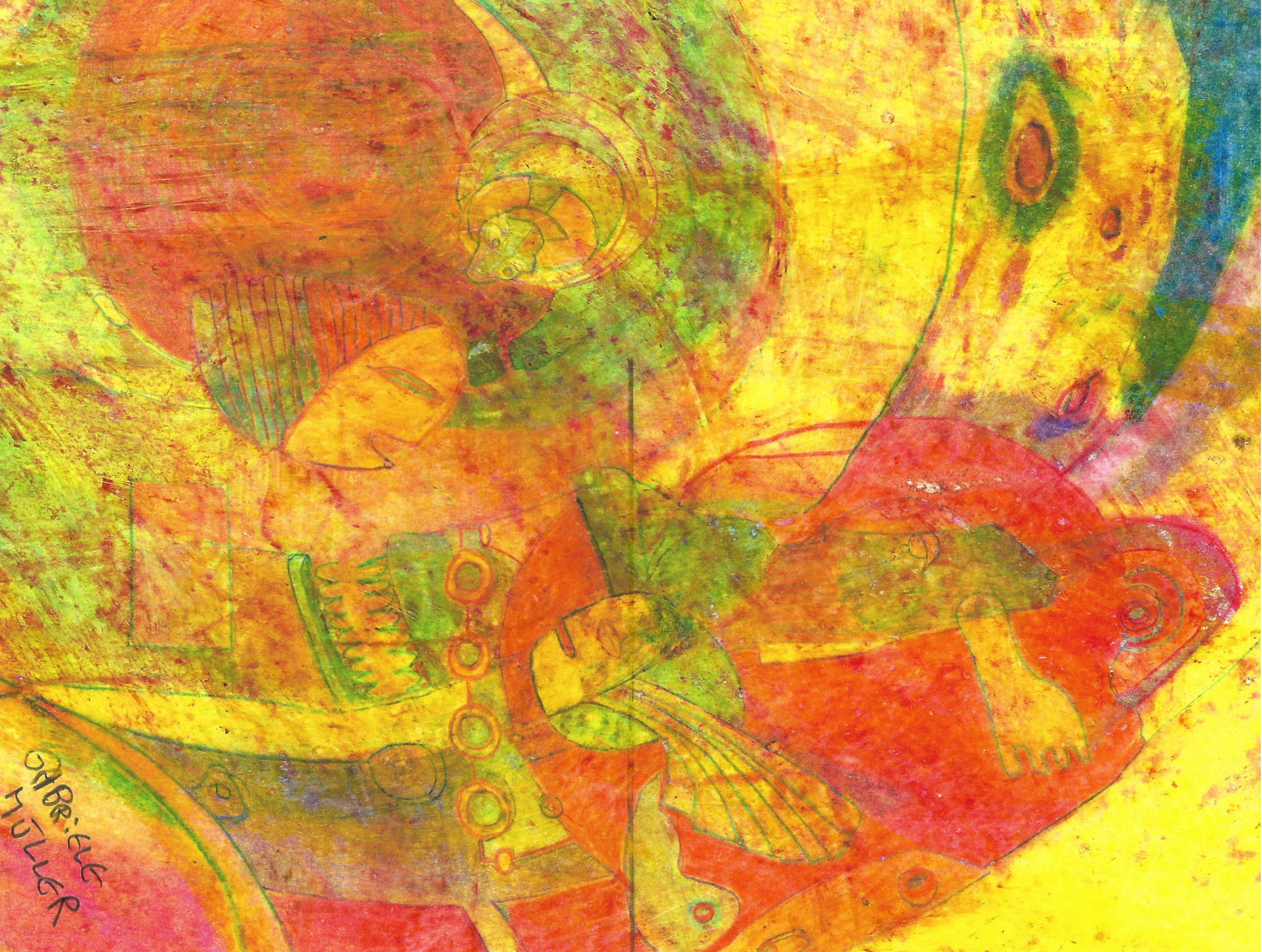
British artists Kevin and James Gillen, the recipients of Gabriele’s watercolor painting to the right, stated on facebook:
“Charming & ‘malevolent’ imagery from Austrian artist Gabriele Müller. Whimsical and colourful but look closely for the sharp teeth and threatening faces …”
Am 13. September ist der internationale Tag der Schokolade. Man kann ihn wahlweise mit dem Verzehr von Pralinen, Mozartkugeln, Mousse, Nougat, Rumkugeln oder einer klassischen Schwarzwälder Kirschtorte begehen.
Dieses Jahr bietet sich darüber hinaus die Lektüre eines eben erschienenen Buches an: Die Literarische Schokoladenauslese enthält auf 300 Seiten Texte von mehr als 100 Autorinnen und Autoren als Ergänzung zum Geschmackserlebnis.
Titel wie “Die Tränen des Chocolatiers”, “Süß und toxisch”, “Kleine Geschenke versüßen den Abend” und “Baum der Versuchung” machen neugierig.
Manchmal kommt die Schokolade auch nur am Rand vor, was die Leser vor einer literarischen Magenverstimmung bewahrt. So erzählt Christina Müller unter dem Titel “Der Mann, der sich nicht einwickeln ließ” die humorvolle Geschichte einer Keilerin (nördlich-deutsch: Drückerin), die es trotz großer Hartnäckigkeit nicht schafft, einem Pensionisten Zeitschriften-Abos aufzuschwatzen.
Als Beitrag von Gerald Jatzek wurde das Gedicht “Der Schokolöwe” in den Band aufgenommen, das Kindern, die man des Diebstahls von Süßigkeiten verdächtigt, ein Alibi verschafft.
Olive trees have provided mankind with wood, fruits and oil since 100,000 years. The cultivation of the olive plant dates back to 5000 years BC. That said, there can be no doubt that the olive has a story to tell.
The Turkish olive mill Özem’le Yaşam wants to collect mail art under the title “Earth of Olive”. Contributions are welcome in the form of paintings, drawings, watercolors, photographs, graphics, emails, cartoons, collages, graffiti, prints, digital images, mixed media, short vides, sculpture, ceramic, designs, a.s.o.
You are free to choose the format of your work.
The contributions should be about olive culture, olives and ecology, history, archaeology, mythology, culture, art gastronomy, wellness, etc.)
Please include your name and last name, country, e-mail, address.
All works will be displayed in Özem’le Yaşam, on this website and as an e-catalog.
Address
Sabriye ÇELİK UĞUZ Balıkesir Üniversitesi, Burhaniye Uygulamalı Bilimler Fakültesi, Örentepe- Burhaniye/ 10700 BALIKESİR TÜRKİYE
“You can accomplish by kindness what you cannot by force”, noted Publilius Syrus (85–43 BC) in his Sententiae some 2000 years ago. The Roman author knew a lot about the subject because he was a slave from Syria who was sold in Rome and later set free and educated by his master.
Right now, kindness is the theme of a mail art call by the city community of La Villetta which is part of the Metropolitan City of Venice. They invite everyone to celebrate kindness and acceptance of differences, and to remember human attitudes such as empathy and tolerance.
If you would like to participate, send your self-designed postcard to:
Comunità La Villetta Via Villetta, 52 30030 Salzano Venezia Italia
The deadline for submissions is November 1. There will be an exhibition in Martellago on November 13, which happens to be World Kindness Day. You can follow the progress on the on the project website.
Copyright
The photo at the top is by Darrenmong / Wikimedia – CC 4.0.











 mail your art