Nature, Human, and Music is the title of an international mail art exhibition organized by Ali Asker Bal for the Korkut Ata University in Osmaniye in the South of Turkey. The call asked artists to pay homage to the composer Béla Bartók who visited the town in 1936 to collect Turkish folk music.
The exhibition features 305 works by 264 participants from 40 countries.
Background: A very Hungarian Composer
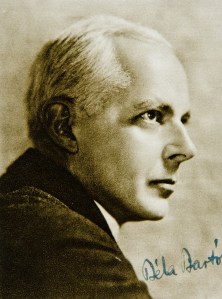
Béla Bartók (1881-1945) was arguably one of the most important composers of the 20th century. Initially successful as a pianist, he developed his personal language as a composer under the influence of Debussy and Hungarian folk music. Subsequently, he also studied musical traditions in Bulgaria, Romania and North Africa.
Béla Bartók
This led to the adoption of ancient pentatonic scales as well as compositions characterized by bitonality (the use of two keys simultaneously).
Bartók was vehemently opposed to the German Nazis and openly criticized Hungary’s alliance with the Axis powers. When Hitler became chancellor in 1933, he immediately stopped performing in Germany. With the outbreak of the Second World War, and despite his strong ties to his homeland, Bartók and his second wife, Ditta Pásztory, decided to move to the United States.
A traveling Ballad
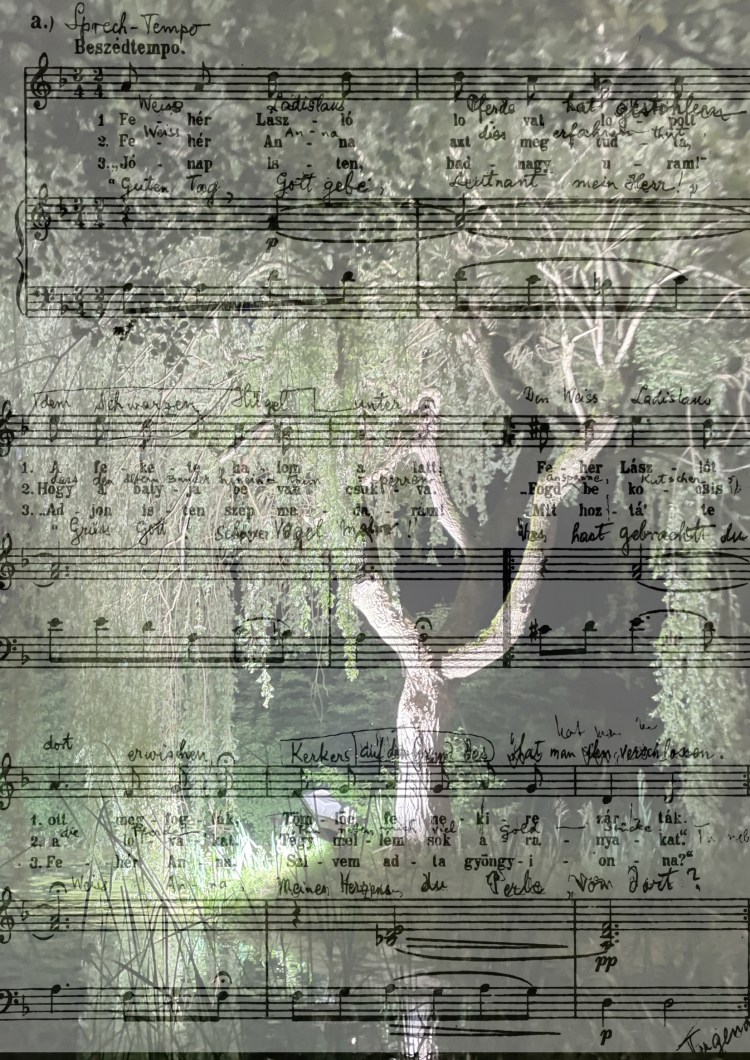
The theme of Gerald Jatzek’s postcard is Bartók’s adaption of the Hungarian folk song Fehér László lovat lopott (László Fehér stole a horse). It is part of the Magyar népdalok (Hungarian Folksongs) for voice and piano by Tivadar Országh und Béla Bartók.
Gerald Jatzek: Fehér László lovat lopott (in homage to Béla Bartók) [full size]
The ballad eventually reached the British Isles where the text was translated by the English singer and collector A.L. Loyd while the music was changed.
This version became popular under the title Anathea. There are renditions by Judy Collins, Joni Mitchell, and Bob Dylan among others. Finally, Led Zeppelin used it as a template for their song Gallows Pole.
While the couple was supported by a research fellowship from Columbia University – they edited a collection of Croatian and Serbian folk music – Bartók’s compositions were hardly known in the USA. Shortly before his death, he was commissioned to write the “Concerto for Orchestra” which was first performed by the Boston Symphony Orchestra conducted by Serge Koussevitzky in December 1944.
Béla Bartók died from leukemia at age 64 in New York City on 26 September 1945.
Béla Bartók Mail Art Project Exhibition
The exhibition at the Osmaniye Cebeli Bereket Cultural Center, Fakıuşağı, 80000 Osmaniye Merkez / Osmaniye, is open between October 22 and November 22.
Marius considers himself a citizen of the world. He is an artist, writer, and translator. When he is not traveling, he splits his time between Indonesia and Europe.
View more posts